

The Internet of Things is referred to as IoT. It describes how actual objects, including cars and appliances, are connected to one another and exchange data because they have sensors, software, and connection built into them. This technology opens the door to more automated and efficient systems by enabling the gathering and sharing of data from a wide network of devices.
The networking of physical items with electronics integrated into their architecture for communication and interaction detection between them or with the outside world is known as the Internet of Things (IoT). IoT-based technology will provide higher-level services in the next years and will essentially transform how people live their daily lives.
History of IOT
Here you will get to know about how IOT is involved and also from the explanation of each will let you know how IOT plays a role in this innovations !
- 1982: Vending machine: The first indication of the Internet of Things appeared when a Carnegie Mellon University vending machine was linked to the internet to communicate its status and inventory, opening the door for remote monitoring.
- Toaster: In 1990, an early example of the Internet of Things (IoT) foreshadowed the ease of smart household appliances when a toaster was linked to the internet and controlled remotely.
- The term “Internet of Things” was first used in 1999 by Kevin Ashton, who laid the groundwork for a new era of connection by describing the network of networked objects that communicate and share data.
- 2000 saw the release of the LG Smart Fridge, a ground-breaking device that demonstrated the promise of the Internet of Things in everyday life by allowing users to remotely monitor and control the refrigerator’s contents.
- 2004 saw the release of the smartwatch, which brought the Internet of Things (IoT) to the wearable technology space by providing notifications and fitness tracking while on the go.
- 2007 saw the release of Apple’s iPhone, which revolutionized the market by combining IoT capabilities with apps that linked consumers to a wide range of devices and services, turning handsets into hubs.
- 2009 saw the introduction of IoT into the automobile sector, which improved cars with sensors for remote testing, performance monitoring, and real-time diagnostics.
- 2011 saw the release of Smart TVs, which allowed internet connectivity for interactive content, streaming, and app use in the living room.
- 2013 saw the release of Google Lens, which demonstrated the Internet of Things’ promise in picture recognition and enabled smartphones to offer details on real-world objects.
- 2014 – Echo: Amazon’s Echo, equipped with the virtual assistant Alexa, demonstrated the power of voice-activated IoT, making smart homes more intuitive and responsive.
- 2015 – Tesla Autopilot: Tesla’s Autopilot system exemplified IoT in automobiles, introducing semi-autonomous driving capabilities through interconnected sensors and software.
Four Key Components of IOT
- Device or sensor
- Connectivity
- Data processing
- Interface
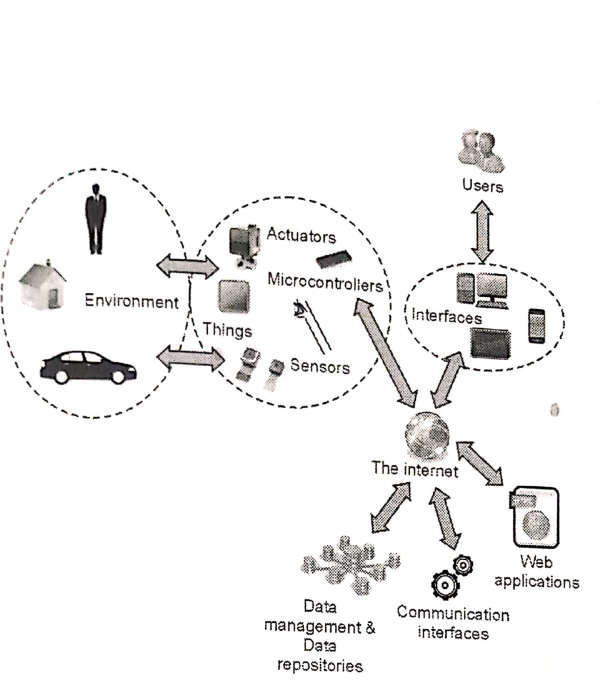
IoT is network of interconnected computing devices which are embedded in everyday objects, enabling them to send and receive data.
Main Components Used in IoT
- Low-power embedded systems: Less battery consumption, high performance are the inverse factors that play a significant role during the design of electronic systems.
- Sensors: Sensors are the major part of any IoT application. It is a physical device that measures and detects certain physical quantities and converts it into signal which can be provided as an input to processing or control unit for analysis purpose.
Different types of Sensors
- Temperature Sensors
- Image Sensors
- Gyro Sensors
- Obstacle Sensors
- RF Sensor
- IR Sensor
- MQ-02/05 Gas Sensor
- LDR Sensor
- Ultrasonic Distance Sensor
- Control units are tiny computers with a microprocessor or processing core, memory, and programmable input/output devices/peripherals all on one integrated circuit. All logical processes are performed here, and it is in charge of the majority of the processing work for IoT devices.
- Cloud computing: A dependable storage server is required to house the vast amounts of data gathered by IoT devices. Cloud computing is useful in this situation. After the data is processed and learned, we have more space to identify the locations of things like electrical defects or faults in the system.
- Big data accessibility: We are aware that sensors play a major role in IoT, particularly in real-time. As these electronic devices proliferate across all industries, their use will cause a huge flux of big data.
- Networking connection: In order to communicate, internet connectivity is a must, where each physical object is represented by an IP address. However, there are only a limited number of addresses available according to the IP naming. Due to the growing number of devices, this naming system will not be feasible anymore. Therefore, researchers are looking for another alternative naming system to represent each physical object.
Ways of Building IOT
There are two ways of building IoT:
- Form a separate internet work including only physical objects.
- Make the Internet ever more expansive, but this requires hard-core technologies such as rigorous cloud computing and rapid big data storage (expensive).
In the near future, IoT will become broader and more complex in terms of scope. It will change the world in terms of
“anytime, anyplace, anything in connectivity.”
IoT Enablers
- RFIDs: uses radio waves in order to electronically track the tags attached to each physical object.
- Sensors: devices that are able to detect changes in an environment (ex: motion detectors).
- Nanotechnology: as the name suggests, these are tiny devices with dimensions usually less than a hundred nanometers.
- Smart networks: (ex: mesh topology).
Working with IoT Devices
- Collect and Transmit Data: Sensors are frequently utilized for this function and are employed in many application areas according to requirements.
- Activate the gadget in response to signals generated by sensors or processing equipment: Actuator devices indicate what action to do if specific triggers are triggered, either in accordance with the user’s wishes or if certain circumstances are met.
- Receive Information: Users or devices can obtain specific information from network devices for processing and analysis.
- The phenomena of communication between two networks or between two or more Internet of Things devices on the same or separate networks is known as communication assistance. Several communication protocols, including ZigBee, FTP, HTTP, MQTT, and Constrained Application Protocol, can accomplish this.
Characteristics of IoT
- Massively scalable and efficient
- IP-based addressing will no longer be suitable in the upcoming future.
- An abundance of physical objects is present that do not use IP, so IoT is made possible.
- Devices typically consume less power. When not in use, they should be automatically programmed to sleep.
- A device that is connected to another device right now may not be connected in another instant of time.
- Intermittent connectivity – IoT devices aren’t always connected. In order to save bandwidth and battery consumption, devices will be powered off periodically when not in use. Otherwise, connections might turn unreliable and thus prove to be inefficient.
Application Domains
IoT is currently found in four different popular domains:
1) Manufacturing/Industrial business - 40.2%
2) Healthcare - 30.3%
3) Security - 7.7%
4) Retail - 8.3%
Advantages of IoT
- Increased productivity and task automation.
- Improved information accessibility and convenience.
- Improved system and device monitoring and control.
- Increased capacity for data collection and analysis.
- Better judgment.
- Savings.
The Drawbacks of IoT
- security issues including the possibility of data leaks or hacking.
- concerns about privacy pertaining to the gathering and application of personal information.
- reliance on technology and the possibility of system malfunctions.
- limited device interoperability and standardization.
- complexity as well as higher maintenance needs.
- high costs of the first investment.
- Some devices have limited battery life.
- worries that automation may cause job dislocation.
- IoT has a weak legal and regulatory foundation, which can cause ambiguity and confusion.
Complete Software Testing Course: Beginner to Advance
O DATA and Internet of Things (IoT)


 WhatsApp us