
Introduction to SAP NetWeaver Gateway
Modern enterprises require seamless communication between systems and user interfaces. In the SAP ecosystem, one of the most important technologies that enables this communication is SAP NetWeaver Gateway. It provides a standardized way to connect SAP backend systems with various applications such as web apps, mobile apps, and cloud platforms. SAP NetWeaver Gateway uses open standards and protocols that allow developers to easily expose SAP data to external applications. One of the core technologies used by SAP NetWeaver Gateway is OData, which works together with REST principles to create lightweight and efficient communication between systems and users. Understanding how OData and REST work inside SAP NetWeaver Gateway is essential for SAP developers, ABAP consultants, and anyone working with SAP Fiori or modern SAP applications.
Understanding the Role of SAP NetWeaver Gateway
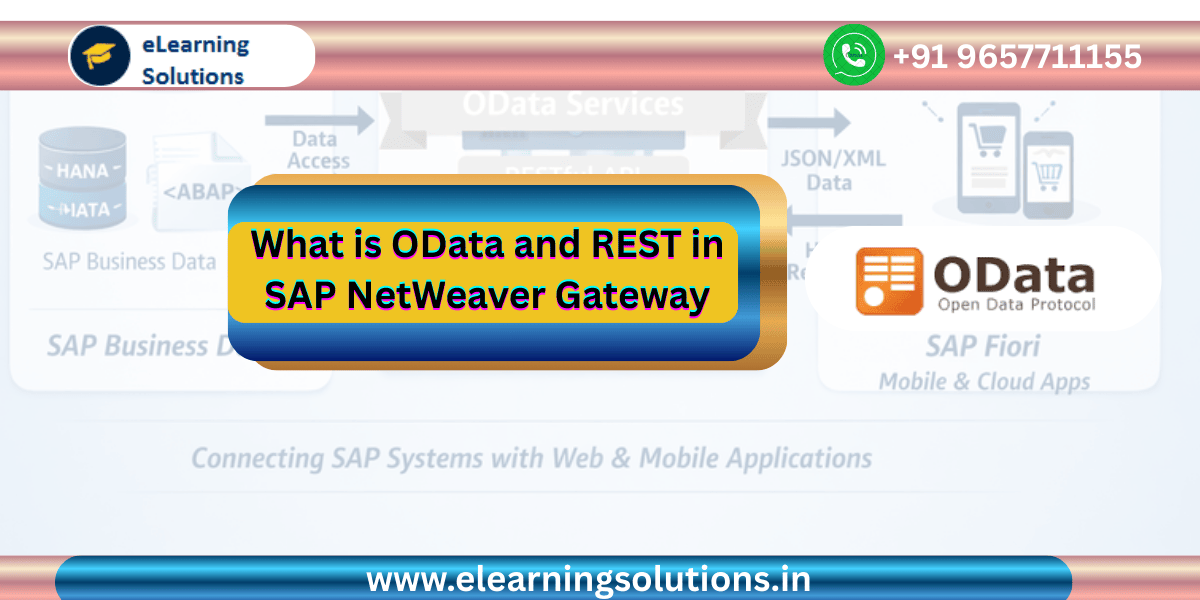
SAP NetWeaver Gateway acts as a bridge between SAP systems and external applications. It provides REST based services that allow applications to access SAP data in a simple and standardized way. Before the introduction of SAP Gateway, integrating SAP data with external systems often required complex middleware or custom integration solutions. With the help of SAP NetWeaver Gateway, developers can expose SAP business data through OData services that can be consumed by any user interface.
These user interfaces may include mobile applications, web dashboards, SAP Fiori applications, or third party software. Because the communication is based on open web standards, developers from different technology backgrounds can easily interact with SAP systems without deep knowledge of the SAP backend architecture.
SAP NetWeaver Gateway essentially transforms SAP data into services that can be accessed through HTTP requests. These services allow users to read, update, create, and delete business data using standard web operations.
What is OData
OData stands for Open Data Protocol. It is a web protocol that allows systems to access and update data using REST based services. OData is built on widely used web technologies such as HTTP, XML, and JSON. Because of this foundation, OData is easy to understand and implement across different platforms and programming languages.
In simple terms, OData provides a standardized method to expose data from a system and allow other applications to interact with that data. It enables developers to retrieve information, filter results, sort data, and perform operations using simple URLs.
For example, if an SAP system exposes sales order data through an OData service, an application can retrieve the list of sales orders using a simple URL request. This makes integration extremely efficient and flexible.
Another way to understand OData is to think of it as database connectivity for the web. Similar to how database drivers allow applications to communicate with databases, OData allows applications to communicate with data services over the internet.
Key Features of OData
OData offers several powerful features that make it widely used in modern SAP development environments.
Standardized Data Access
OData provides a uniform way to access data across different systems. This ensures consistency when applications interact with enterprise data.
Built on Web Standards
Since OData relies on HTTP and JSON or XML formats, it is compatible with almost every programming language and framework used today.
Easy Data Filtering and Querying
OData allows users to filter and manipulate data directly through the service URL. Developers can request only the data they need instead of retrieving large datasets.
Platform Independent Integration
Applications built using Java, JavaScript, Python, .NET, or mobile technologies can easily consume OData services.
Seamless Integration with SAP Fiori
SAP Fiori applications heavily rely on OData services to communicate with SAP backend systems. This makes OData a core technology for modern SAP user interfaces.
What is REST
REST stands for Representational State Transfer. It is not a protocol but an architectural style used to design networked applications. REST is based on standard HTTP communication methods and focuses on simplicity, scalability, and performance.
In a REST based architecture, resources are identified using URLs and accessed using standard HTTP operations such as GET, POST, PUT, and DELETE. Each request sent from the client contains all the necessary information for the server to process it.
REST has become the most popular architecture for web APIs because it is lightweight and easy to implement.
Core Principles of REST Architecture
For an application to be considered RESTful, it must follow several architectural constraints.
Client Server Architecture
The client and server operate independently. The client handles the user interface while the server manages the data and business logic.
Stateless Communication
Every request from the client must contain all the information needed to process it. The server does not store client session information between requests.
Cacheable Responses
Responses from the server can be cached to improve performance and reduce unnecessary processing.
Layered System
REST architecture supports multiple layers such as security layers, gateways, and load balancers without affecting communication between the client and server.
Uniform Interface
REST APIs use consistent resource identification and interaction methods, making them easy to understand and use.
Code on Demand
In some cases, the server can send executable code to the client to extend functionality.
Relationship Between OData and REST
OData is built on top of REST principles. While REST defines the architectural style, OData defines the specific rules and standards for accessing and manipulating data.
REST provides the structure for communication, while OData provides the protocol that organizes data access and operations.
In SAP NetWeaver Gateway, OData services follow REST architecture. This means that business data is exposed as resources that can be accessed through HTTP requests.
For example, a request to retrieve sales orders might look like this:
/sap/opu/odata/sap/ZSALESORDER_SERVICE/SalesOrderSet
If a developer wants to retrieve a specific sales order, the request can include the sales order number in the URL.
This simple approach makes it very easy for applications to interact with SAP data.
Difference Between SAP NetWeaver Gateway and SAP PI
Many SAP professionals often confuse the role of SAP NetWeaver Gateway and SAP Process Integration.
Although both technologies are used for communication and integration, their purpose is different.
SAP Process Integration focuses on system to system communication. It is used to exchange data between different enterprise systems, business partners, or external platforms.
SAP NetWeaver Gateway focuses on system to user communication. It enables user interfaces such as mobile apps or web applications to access SAP data directly.
For example, if a company wants to integrate its SAP system with a third party logistics platform, SAP Process Integration may be used.
However, if a company wants to display sales order data inside a mobile application, SAP NetWeaver Gateway and OData services would be the preferred approach.
Real Example of OData in SAP Applications
Imagine a company that wants to create a mobile application for its sales team. The sales representatives need to check customer orders while visiting clients.
Using SAP NetWeaver Gateway, developers can create an OData service that exposes sales order data from the SAP system.
The mobile application sends an HTTP request to retrieve the data. The SAP Gateway processes the request, retrieves the required information from the backend system, and returns the response in JSON format.
The mobile application then displays the data in an easy to understand format for the user.
This process happens in seconds and provides real time access to SAP business data.
Advantages of Using OData in SAP
There are several reasons why OData has become a standard technology in the SAP ecosystem.
First, it simplifies integration with modern web technologies. Developers can build user interfaces using JavaScript frameworks and easily connect them to SAP systems.
Second, it reduces development complexity by providing a consistent data access model.
Third, it improves scalability and performance by allowing selective data retrieval.
Fourth, it supports cloud based development environments such as SAP Business Technology Platform.
Finally, it enables rapid development of modern user experiences through SAP Fiori applications.
Practical Tips for SAP Developers Working with OData
SAP developers who work with OData services can improve their development workflow by following several best practices.
Always design OData services with performance in mind. Avoid returning unnecessary data fields and use filtering options whenever possible.
Use proper naming conventions for entity sets and service structures to make APIs easier to understand.
Test OData services using tools such as the SAP Gateway Client before integrating them with applications.
Implement security measures such as authentication and authorization to protect sensitive business data.
Finally, document OData services clearly so that other developers can easily understand and consume them.
Future of OData and REST in SAP
With the rapid growth of cloud applications, APIs, and microservices architecture, the importance of REST based services continues to grow. OData plays a crucial role in enabling SAP systems to participate in modern digital ecosystems.
Technologies such as SAP Fiori, SAP Business Technology Platform, and SAP S4HANA rely heavily on OData services to deliver modern user experiences.
As organizations continue their digital transformation journey, the demand for developers who understand OData and REST architecture will continue to increase.
Learning these technologies is therefore an essential step for anyone pursuing a career in SAP development or enterprise integration.
Conclusion
OData and REST are fundamental technologies that power modern SAP integrations. SAP NetWeaver Gateway uses OData services built on REST architecture to expose SAP business data in a simple and standardized way. This approach allows developers to build powerful applications that interact with SAP systems using common web technologies. By understanding how OData works and how it fits into the SAP architecture, developers can create scalable, efficient, and user friendly applications that support modern business requirements. As SAP continues to evolve toward cloud based and API driven environments, mastering OData and REST will remain a valuable skill for SAP professionals.
YOU MAY BE INTERESTED IN
ABAP Evolution: From Monolithic Masterpieces to Agile Architects
A to Z of OLE Excel in ABAP 7.4




 WhatsApp us