
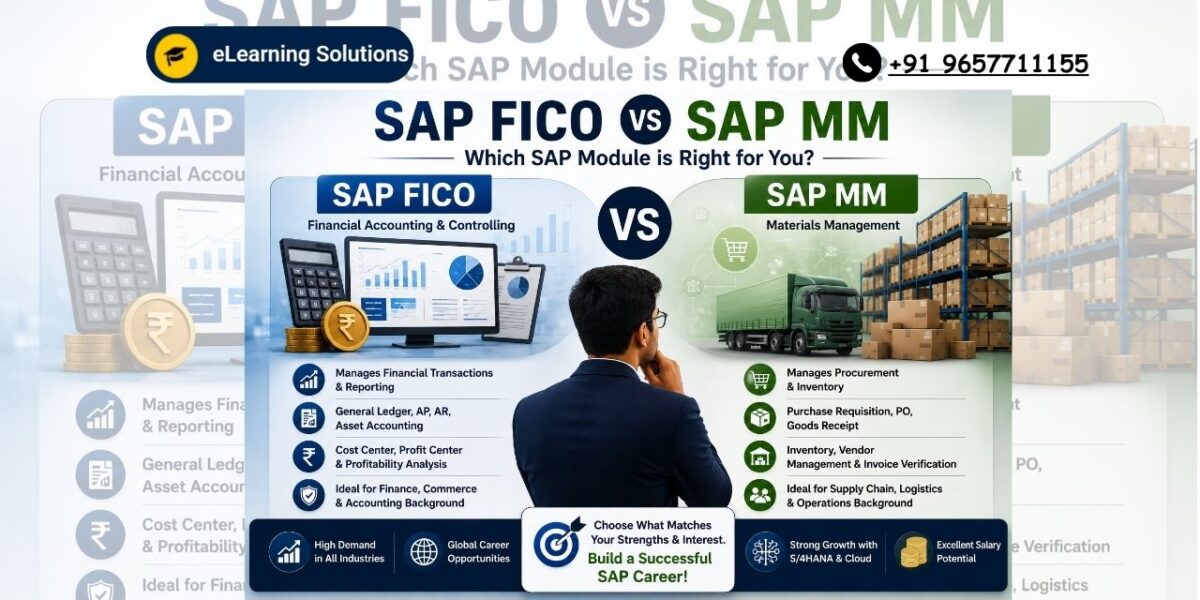
Choosing between SAP FICO and SAP MM is one of the most common dilemmas for anyone starting a career in the SAP ecosystem. Both modules are pillars of the enterprise resource planning world, but they lead to fundamentally different career paths that appeal to distinct skill sets and interests. This guide will help you understand the core differences, evaluate your own strengths, and make a confident decision about which path is right for you.
The most important distinction lies in what each module actually does. SAP FICO, which stands for Financial Accounting and Controlling, is the financial backbone of the enterprise, managing everything from general ledger accounting to profitability analysis. It is divided into two main components: FI, which handles external accounting and legal reporting for areas like accounts payable, accounts receivable, and asset accounting, and CO, which deals with internal cost accounting for management decisions such as cost center and profit center analysis . If you are a numbers person who loves structure, compliance, and analytical thinking, FICO is your natural habitat. The demand for FICO professionals is consistently high because every company, regardless of industry, must maintain accurate financial records, making it one of the most stable and universally required modules in the SAP landscape .
SAP MM, or Materials Management, operates on a completely different plane. This module is the engine of the supply chain, handling the entire procurement and inventory lifecycle—from identifying a need for materials and sourcing vendors, to creating purchase orders, managing warehouse stock, and verifying invoices . If your interests lie in logistics, operations, and the tangible flow of goods through a business, MM is the module for you. MM professionals are essential in manufacturing, retail, and distribution industries where efficient procurement and inventory control are critical to profitability . The role involves optimizing processes and ensuring that the right materials are available at the right time, cost, and quantity.
The decision between these two modules should be driven by your educational background and natural interests. For commerce, accounting, or finance graduates, SAP FICO is the most logical and straightforward path because the concepts of debits, credits, and financial reporting will already be familiar to you . Your existing knowledge will allow you to transition more smoothly into SAP configuration and focus on learning the system rather than the business rules. For those with a background in supply chain management, procurement, logistics, or industrial engineering, SAP MM is a perfect fit . You already understand how supply chains operate and how materials flow, making the transition to configuring MM processes a natural progression.
When it comes to career growth and salary potential, both modules offer excellent trajectories, though they lead to different types of roles. A career in SAP FICO offers one of the most stable and rewarding paths in the IT-finance domain. The progression is clear and structured, starting from a Junior Consultant (0–2 years), moving to a Functional Consultant (2–5 years), then advancing to Senior Consultant roles (5–8 years), and eventually growing into Architect, Product Owner, or Project Manager positions after 8+ years . In India, freshers can expect to start between ₹3–5 LPA, with mid-level consultants earning ₹7–12 LPA, senior roles reaching ₹12–18 LPA, and manager-level professionals earning ₹18–30 LPA or more . The rise of S/4HANA Finance has significantly boosted salary prospects for FICO experts.
For SAP MM professionals, the career growth also follows a structured path from junior consultant to architect-level roles, with opportunities to specialize in areas like S/4HANA sourcing and procurement, supply chain management, or procurement solution architecture . MM consultants are in high demand across sectors like manufacturing, retail, pharmaceuticals, and automotive . An SAP MM consultant with strong functional experience can move into hybrid roles that combine domain knowledge with SAP skills, eventually advancing to leadership positions like SCM Architect or Program Manager . The key differentiator is the type of work you will be doing. FICO roles are deeply analytical and focused on financial reporting, compliance, and cost control, while MM roles are centered on process optimization, logistics, and operational efficiency .
It is also important to consider the integration between these modules. In a real-world SAP implementation, MM and FICO are deeply integrated. For example, the Procure-to-Pay cycle involves both modules: MM handles the purchase order and goods receipt, while FICO manages the invoice verification and payment posting . This integration means that professionals in either module need to understand the basics of the other to be effective. The current wave of S/4HANA migrations is driving demand for both specializations, as organizations need experts to handle both the financial transformation and the supply chain optimization aspects of their digital journeys. Both modules are evolving with modern technologies, with Fiori apps and embedded analytics becoming essential tools for consultants in both domains .
To make your final decision, ask yourself two key questions. First, what is your educational background and professional experience? If you have a background in commerce, accounting, or finance, FICO is the natural choice. If your background is in supply chain, logistics, or procurement, MM is the better fit. Second, what type of work excites you? Do you enjoy analyzing financial data, ensuring regulatory compliance, and working with numbers? Or do you prefer optimizing operational processes, managing vendor relationships, and overseeing the flow of physical goods? Your answers to these questions will point you toward the right path.
In conclusion, there is no universally “better” module between SAP FICO and SAP MM. Both are critical components of the SAP ecosystem and offer outstanding career opportunities with strong job security, competitive salaries, and clear paths for advancement. The choice between them ultimately depends on who you are. If you are passionate about finance and accounting, love numbers, and enjoy ensuring financial integrity and compliance, SAP FICO is your path to a stable and highly rewarding career. If you are fascinated by supply chains, operations, and the flow of materials, and you enjoy practical, process-oriented problem-solving, SAP MM is the right module for you. Choose the path that aligns with your natural strengths and interests, and you will build a successful and fulfilling career in the dynamic world of SAP.
YOU MAY BE INTERESTED IN
ABAP Evolution: From Monolithic Masterpieces to Agile Architects
A to Z of OLE Excel in ABAP 7.4




 WhatsApp us