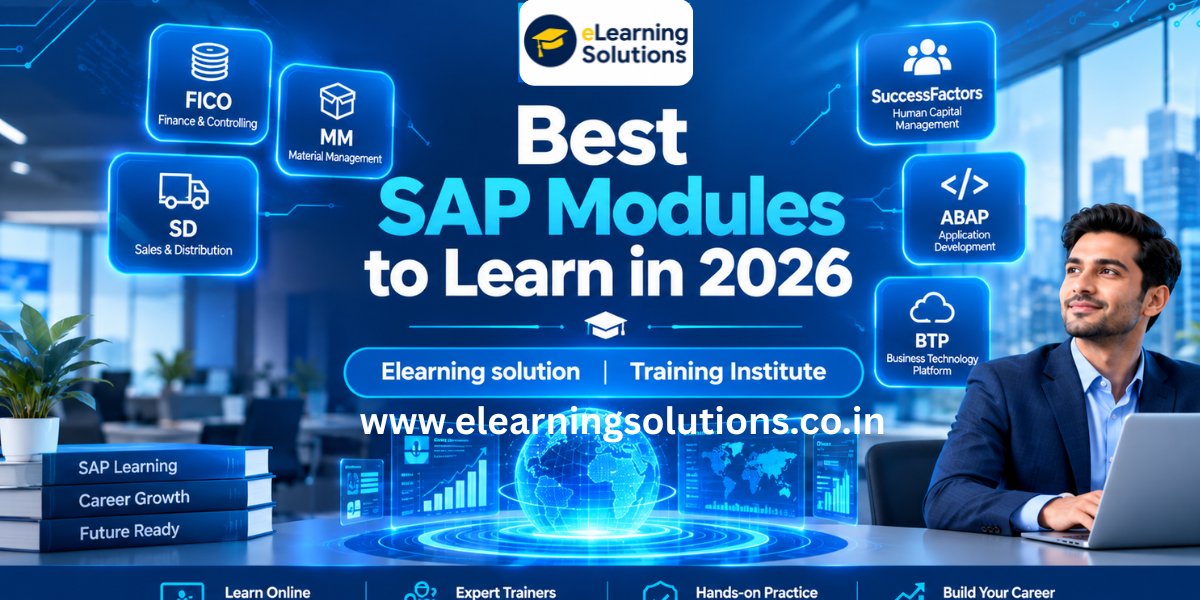
Best SAP Modules to Learn in 2026 for High-Paying Jobs
Introduction to SAP and Its Importance in the Modern Business World
SAP has become an important technology for businesses looking to manage their operations efficiently, improve productivity, and make data-driven decisions. From finance and sales to materials management and production planning, SAP supports critical business processes across industries.
For fresh graduates, working professionals, and IT professionals looking to upgrade their skills, learning the right SAP module can open the door to promising career opportunities.
In this guide, we will explore the best SAP modules to learn in 2026, their career applications, learning requirements, and how to choose the right SAP training program.
What Is SAP?
SAP stands for Systems, Applications, and Products in Data Processing. SAP provides enterprise software solutions that help organizations manage business operations and customer-related processes.
SAP solutions cover several areas, including finance, human resources, sales, procurement, supply chain management, manufacturing, analytics, and more.
By integrating different business functions into a centralized system, SAP helps organizations manage information efficiently and coordinate processes across departments.
Why Should You Learn SAP in 2026?
Learning SAP can help professionals develop skills that are directly applicable to business operations and enterprise technology.
Companies across different industries use SAP solutions to manage their financial, supply chain, sales, production, and human resource processes. As organizations continue adopting digital business systems, professionals with relevant SAP skills can explore opportunities in consulting, implementation, support, development, and business process management.
Some important benefits of learning SAP include:
-
Development of enterprise technology skills
-
Opportunities across multiple industries
-
Career options for both freshers and experienced professionals
-
Exposure to real-world business processes
-
Opportunities to specialize in functional or technical SAP roles
-
Potential for long-term career growth
Top SAP Modules to Learn in 2026
Choosing the right SAP module depends on your educational background, professional experience, career interests, and the type of work you want to pursue.
SAP FICO – Financial Accounting and Controlling
SAP FICO is one of the most popular functional areas in SAP. It focuses on financial accounting and controlling processes used by organizations to manage their financial operations.
SAP FICO covers areas such as:
-
General ledger accounting
-
Accounts payable
-
Accounts receivable
-
Asset accounting
-
Cost center accounting
-
Profit center accounting
-
Financial reporting
SAP FICO can be a suitable choice for accounting, finance, commerce, and business professionals who want to build a career in SAP consulting or finance-related technology roles.
SAP MM – Materials Management
SAP MM focuses on procurement, inventory, and materials management processes.
The module is commonly associated with:
-
Purchasing
-
Procurement
-
Inventory management
-
Material master data
-
Vendor management
-
Goods receipt
-
Invoice verification
Professionals with backgrounds in procurement, supply chain, purchasing, materials management, and logistics can consider SAP MM as a potential career path.
SAP SD – Sales and Distribution
SAP SD manages important sales-related business processes, from customer orders to delivery and billing.
Major areas include:
-
Customer master data
-
Sales orders
-
Pricing
-
Delivery processing
-
Shipping
-
Billing
-
Sales reporting
SAP SD can be useful for professionals interested in sales operations, logistics, customer management, and business process consulting.
SAP PP – Production Planning
SAP PP is designed for organizations involved in manufacturing and production.
It supports processes such as:
-
Production planning
-
Material requirements planning
-
Production orders
-
Scheduling
-
Capacity planning
-
Shop-floor processes
SAP PP can be particularly relevant for professionals with manufacturing, production planning, engineering, and operations backgrounds.
SAP HCM – Human Capital Management
SAP HCM focuses on managing employee-related processes within an organization.
It can include areas such as:
-
Personnel administration
-
Organizational management
-
Time management
-
Payroll
-
Employee data management
Professionals with an HR or payroll background can consider SAP HCM as a specialization.
SAP ABAP – Advanced Business Application Programming
SAP ABAP is one of the key technical areas within the SAP ecosystem. ABAP professionals work on developing and customizing applications within SAP environments.
ABAP learning can involve:
-
ABAP programming
-
Reports
-
Data Dictionary
-
Internal tables
-
Modularization
-
Function modules
-
Object-oriented programming
-
Enhancements
-
Forms
-
Database programming
SAP ABAP can be a suitable option for graduates and professionals with programming, software development, or technical backgrounds.
How to Choose the Right SAP Module
There is no single SAP module that is best for everyone. Your choice should depend on your background and career objective.
For example:
| Background | SAP Module to Consider |
|---|---|
| Finance or Accounting | SAP FICO |
| Procurement or Supply Chain | SAP MM |
| Sales or Distribution | SAP SD |
| Manufacturing or Production | SAP PP |
| Human Resources | SAP HCM |
| Programming or IT | SAP ABAP |
Understanding your existing skills can make it easier to select a suitable SAP learning path.
Who Can Learn SAP?
SAP is not limited to experienced IT professionals. Fresh graduates and professionals from different educational backgrounds can learn SAP with the right training approach.
People from backgrounds such as:
-
Commerce
-
Finance
-
Accounting
-
Business Administration
-
Engineering
-
Computer Science
-
Information Technology
-
Human Resources
-
Supply Chain and Logistics
can explore SAP based on their career interests.
Is Prior Experience Required to Learn SAP?
Prior experience can be helpful, but it is not always necessary.
Fresh graduates can begin with the fundamentals of their selected SAP module and gradually develop their knowledge through structured training and practical exercises.
Experienced professionals can also use SAP training to combine their existing industry knowledge with enterprise technology skills.
The key is to choose a learning path that matches your background and career goals.
How to Learn SAP Effectively
Learning SAP requires more than simply understanding theoretical concepts. Practical exposure is important for developing confidence with business processes and SAP environments.
A good SAP learning approach can include:
Learn the Fundamentals
Start by understanding the purpose of your selected SAP module and how it fits into real business processes.
Practice Regularly
Hands-on practice can help you understand how SAP transactions and processes work in practical situations.
Work on Realistic Scenarios
Try to understand business scenarios instead of learning individual concepts in isolation. This can help you connect SAP functionality with real organizational requirements.
Develop Problem-Solving Skills
SAP professionals often need to analyze business requirements and identify suitable solutions. Developing problem-solving skills can therefore be valuable for your career.
Learn SAP with eLearning Solutions
Choosing the right training institute can make your SAP learning journey more structured and practical.
eLearning Solutions provides SAP training for learners who want to develop practical enterprise technology skills. The training approach is designed for freshers and working professionals looking to understand SAP concepts and prepare for career opportunities.
At eLearning Solutions, learners can explore SAP courses such as:
-
SAP FICO
-
SAP MM
-
SAP SD
-
SAP PP
-
SAP HCM
-
SAP ABAP
-
SAP HANA
-
SAP BASIS
-
SAP S/4HANA
The training can help learners build their understanding through structured learning, practical exposure, and career-focused guidance.
You can explore available SAP training programs at elearningsolutions.co.in.
Online vs Offline SAP Training
Both online and classroom training can be effective. The right option depends on your schedule, learning preferences, and location.
Online SAP Training
Online learning can be useful for working professionals and students who want flexibility. Learners can attend sessions remotely and study from their preferred location.
Classroom SAP Training
Classroom training can provide direct interaction with trainers and other learners. It can be useful for students who prefer face-to-face guidance and a structured learning environment.
eLearning Solutions provides training options designed to support learners with different learning requirements.
Career Opportunities After Learning SAP
SAP skills can open opportunities across several industries, including manufacturing, retail, finance, healthcare, logistics, technology, and consulting.
Depending on your specialization and experience, potential career paths can include:
-
SAP Consultant
-
SAP Functional Consultant
-
SAP Technical Consultant
-
SAP ABAP Developer
-
SAP Support Professional
-
SAP Business Analyst
-
SAP Application Consultant
Your career opportunities will depend on your SAP specialization, practical knowledge, experience, and ability to understand business requirements.
How to Prepare for an SAP Career
Completing a training course is only one part of becoming job-ready. You should also focus on practical and professional skills.
Build Practical Knowledge
Practice your SAP concepts regularly and work through realistic business scenarios.
Improve Your Resume
Highlight your SAP skills, projects, practical exposure, educational background, and relevant experience clearly on your resume.
Prepare for Interviews
SAP interviews can include technical questions, functional questions, business scenarios, and questions about your practical understanding.
Keep Learning
SAP continues to evolve with technologies such as SAP S/4HANA and cloud-based solutions. Continuous learning can help you stay relevant in the industry.
Common Mistakes to Avoid When Learning SAP
Choosing a Module Without Understanding Your Career Goal
Do not select a module simply because it is popular. Consider whether it matches your educational background and career interests.
Focusing Only on Theory
SAP is closely connected to real business processes. Practical learning is important for developing confidence.
Skipping Practice
Regular practice can help reinforce concepts and improve your understanding of SAP transactions and processes.
Ignoring Interview Preparation
Technical knowledge alone may not be enough during a job search. Resume preparation, communication skills, and interview practice can also be important.
Is Learning SAP Worth It in 2026?
Yes, SAP can be a valuable career skill for professionals interested in enterprise technology, business processes, consulting, and IT.
The best results come from choosing the right module, learning the fundamentals, gaining practical exposure, and continuously improving your skills.
Instead of trying to learn every SAP module, focus on one specialization that aligns with your career goals and build strong expertise in that area.
Frequently Asked Questions
What is SAP?
SAP is enterprise software used by organizations to manage business processes such as finance, sales, procurement, inventory, production, and human resources.
Which SAP module is best for beginners?
The best module depends on your educational and professional background. Finance professionals may consider SAP FICO, supply chain professionals may consider SAP MM, sales professionals may consider SAP SD, and IT or programming professionals may consider SAP ABAP.
Can freshers learn SAP?
Yes. Fresh graduates can learn SAP by starting with the fundamentals and developing practical knowledge through structured training and regular practice.
Is prior experience required for SAP training?
Prior experience can be helpful but is not always required. Beginners can start with foundational SAP training.
How long does it take to learn SAP?
The learning time depends on the module, training structure, previous knowledge, and time dedicated to practice. A structured SAP course can help learners progress systematically.
Is SAP a good career option in 2026?
SAP can be a strong career option for people interested in enterprise technology and business processes. Career opportunities depend on specialization, practical skills, experience, and industry requirements.
Where can I learn SAP in Pune?
Learners looking for SAP training in Pune can explore the courses available through eLearning Solutions and choose a module based on their educational background and career goals.
Start Your SAP Learning Journey with eLearning Solutions
Learning the right SAP module can be an important step toward building a career in enterprise technology. Whether you are a fresher looking for your first opportunity or a working professional planning a career transition, developing practical SAP skills can help you move toward your career goals.
eLearning Solutions provides SAP training designed to help learners understand SAP concepts, develop practical knowledge, and prepare for professional opportunities.
Explore SAP courses and training programs at elearningsolutions.co.in and choose the SAP specialization that matches your career goals.
YOU MAY BE INTERESTED IN
How to Convert JSON Data Structure to ABAP Structure without ABAP Code or SE11?
ABAP Evolution: From Monolithic Masterpiece




 WhatsApp us