
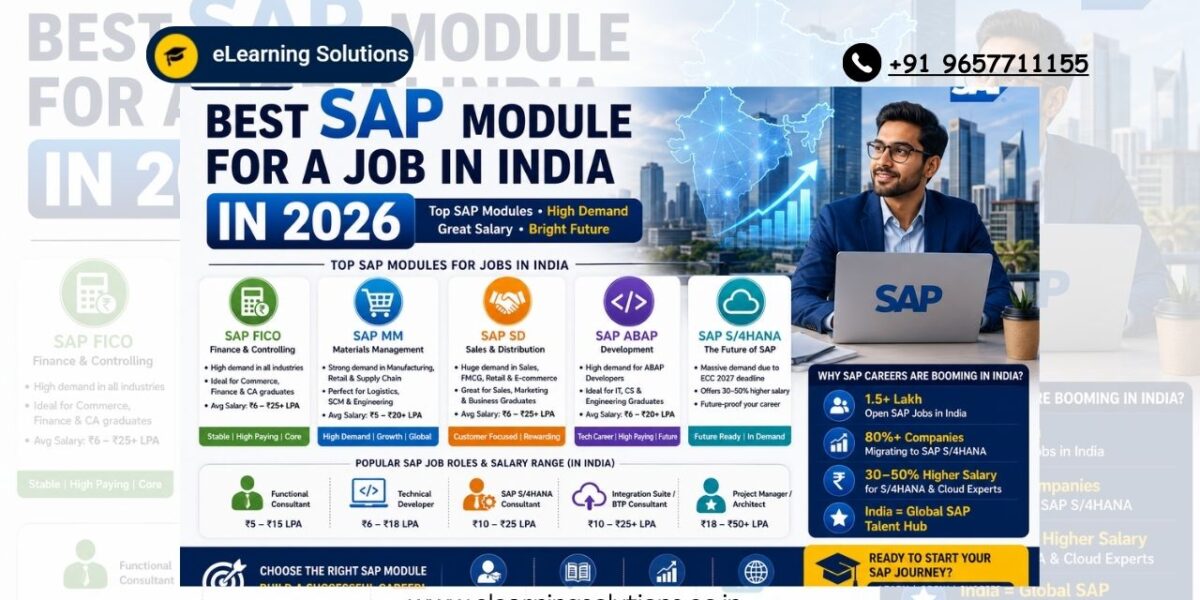
The Indian job market for SAP professionals is currently experiencing a period of unprecedented growth, driven by a massive wave of digital transformation across industries. With the global deadline for SAP ECC support ending in 2027, thousands of companies are racing to migrate to the modern S/4HANA platform, creating a talent shortage that is pushing salaries to record highs and opening doors for both fresh graduates and experienced professionals . For anyone asking “Which SAP module is best for a job in India in 2026?”, the answer is not a single module, but a strategic choice that aligns with your educational background, personal interests, and the specific demands of India’s booming IT hubs like Pune, Bangalore, and Hyderabad.
The Indian SAP ecosystem is incredibly vibrant and deep. India is home to the largest SAP talent pool outside of Germany, with companies like TCS, Infosys, Wipro, and Accenture employing tens of thousands of SAP-certified professionals . This concentration of expertise, combined with a strong cost advantage, makes India the global hub for SAP implementations and support. Right now, there are over 1.5 lakh open SAP jobs in India across platforms like Naukri and LinkedIn, yet only about 20% of the workforce is SAP certified . This massive supply-demand gap represents a golden opportunity for anyone looking to enter the field. The key is to choose a module that not only offers a high salary but also provides long-term career stability and growth.
The first and most critical step is to classify SAP modules into two main categories: Functional and Technical. This distinction determines your entire career trajectory. Functional modules are business-facing and map specific business operations like finance, procurement, sales, and human resources. If you have a background in commerce, finance, supply chain, or sales, these are your natural fit. Technical modules, on the other hand, are system-facing and focus on coding, system administration, and database management. If you come from a computer science or engineering background and enjoy programming and system architecture, you will thrive in a technical role. Understanding this fundamental difference is the key to making a decision that will bring you long-term satisfaction and success.
For individuals with a commerce, accounting, or finance background, SAP FICO remains the undisputed king of functional modules in India. SAP FICO, which stands for Financial Accounting and Controlling, is the backbone of any business because every company, regardless of its industry, needs to manage its finances. The FI module handles core accounting processes like general ledger, accounts payable and receivable, and asset accounting, while the CO module dives into cost center accounting, profitability analysis, and internal reporting. This module is ideal for CAs, CIMAs, ACCAs, CPAs, and commerce graduates, as it directly leverages their existing knowledge of financial principles. The demand for FICO consultants is consistently high, with entry-level salaries ranging from ₹4 to ₹6 LPA, and experienced professionals earning upwards of ₹12 LPA or more, with senior architects and managers commanding ₹25 LPA to ₹50 LPA . The average salary for an SAP consultant with FICO skills is around ₹5.96 Lakhs, and the highest earners can make up to ₹2 million per year . This is a stable, high-paying career with opportunities in virtually every sector, from banking to manufacturing.
If your interests lie in supply chain, procurement, and logistics, then SAP MM is the module for you. SAP MM, or Materials Management, handles the entire procurement cycle, from purchase requisitions to goods receipt and invoice verification, as well as inventory and vendor management. This module is incredibly popular in India, especially in manufacturing hubs like Pune and Chennai, where the demand for MM professionals is exceptionally high . Many consider SAP MM relatively easier for beginners to grasp because its processes are logical and straightforward, making it a great starting point for fresh graduates. With the global supply chain becoming increasingly complex, the demand for skilled MM consultants is only rising. MM consultants can expect salaries similar to FICO, with entry-level roles starting at ₹5-10 LPA and senior specialists earning significantly more . This module is particularly well-suited for candidates with a background in supply chain management, logistics, or industrial engineering.
For those with a sales, marketing, or business administration background, SAP SD offers a clear and exciting career path. SAP SD, or Sales and Distribution, focuses on the entire order-to-cash cycle, managing everything from customer inquiries and sales orders to pricing, delivery, shipping, and billing. It is a customer-facing module that directly impacts a company’s revenue, making it a strategically important function. The demand for SD consultants is broad, as sales are central to most businesses, especially in thriving sectors like FMCG, retail, automotive, and e-commerce . SD consultants are often valued as all-rounders who understand complex business processes and integrate well with logistics and finance. Entry-level salaries for SD consultants range from ₹6 to ₹18 LPA, with senior architects and project managers earning ₹25 to ₹50 LPA . This module is a fantastic fit for individuals who are people-oriented and enjoy the dynamic nature of sales operations.
For graduates with a technical background in IT or computer science, SAP ABAP remains the most foundational and highest-paying technical skill. ABAP is the primary programming language used to customize, enhance, and develop new applications within the SAP environment. ABAP developers create reports, interfaces, forms, and custom programs to meet specific business needs that standard configurations cannot address. The demand for skilled ABAP developers is consistently high because every SAP implementation requires technical expertise to tailor the system. With the shift to S/4HANA, ABAP developers who are proficient in the modern ABAP on HANA, including CDS views and OO ABAP, are in even higher demand and command premium salaries . An ABAP developer’s starting salary is often in the ₹4-6 LPA range, but this can double within a few years. Senior ABAP architects, especially those with S/4HANA experience, can earn ₹20 LPA and beyond . This module is perfect for those who enjoy problem-solving and coding.
Beyond these core four modules, there are several other specializations that are rapidly gaining traction in India. The most significant of these is the SAP S/4HANA suite. The 2027 end-of-maintenance deadline for ECC is a major driver of the current job market, creating a massive demand for consultants who can lead S/4HANA migration projects . These are often hybrid roles, requiring deep functional or technical knowledge combined with an understanding of the S/4HANA data model, Fiori user interface, and integration with SAP Business Technology Platform (BTP). Gartner has estimated that 80% of SAP customers hadn’t completed their migration strategy by 2025, which means the demand for S/4HANA talent will continue to surge for the foreseeable future . Professionals with S/4HANA migration experience can command a 30-50% salary premium over standard SAP rates, making it one of the most lucrative specializations available .
In the cloud and HR space, SAP SuccessFactors is one of the fastest-growing modules as companies transition from on-premise SAP HCM to cloud-based solutions. SuccessFactors manages the entire employee lifecycle, from recruiting and onboarding to performance management and payroll. This is a highly strategic area for businesses, and the demand for SuccessFactors consultants is rising sharply, especially in multinational companies operating in India . This module is ideal for HR professionals looking to leverage technology to drive business outcomes and can lead to highly rewarding careers. Similarly, the SAP Integration Suite, which is crucial for connecting SAP with other systems in a hybrid IT environment, is a critical skill for the modern SAP landscape. As the older PI/PO system retires, expertise in the SAP Cloud Platform Integration (CPI) is becoming essential, with professionals in this niche being highly sought after .
To make the best decision, you should follow a structured self-assessment process. Start by identifying your educational background and natural interests. Are you a numbers person? Do you love working with people? Are you a techie at heart? Your past experience is the best indicator of where you will excel. Next, research the job market in your target city. For example, Pune is a major hub for SAP MM and PP due to its manufacturing base, while Bangalore leads in IT services and analytics roles. Finally, consider the long-term trajectory. While starting with a functional module like MM or SD provides a strong business foundation, starting with ABAP or BASIS can lead to a high-paying technical architect role. Many successful SAP professionals start with one module and then expand their skills into newer technologies like S/4HANA and BTP to future-proof their careers. Institutions that offer a wide range of SAP courses, like eLearning Solutions in Pune, provide a great starting point to explore your options and get the practical, hands-on training needed to succeed .
In conclusion, the best SAP module for a job in India in 2026 is the one that best fits your unique profile. For commerce and finance graduates, FICO is a clear winner for its stability and high demand. For supply chain enthusiasts, MM offers a logical and rewarding path. For sales and marketing graduates, SD is a natural choice with excellent earning potential. And for technical graduates, ABAP provides a robust and high-paying career in development. Each of these core modules is a gateway to a successful SAP career, especially when combined with S/4HANA and cloud-based skills. The Indian SAP job market is booming, and the opportunities are immense for those who take the first step. By choosing your module wisely and investing in quality training, you can build a career that is not only financially rewarding but also offers global opportunities and long-term stability.
YOU MAY BE INTERESTED IN
ABAP Evolution: From Monolithic Masterpieces to Agile Architects
A to Z of OLE Excel in ABAP 7.4




 WhatsApp us