
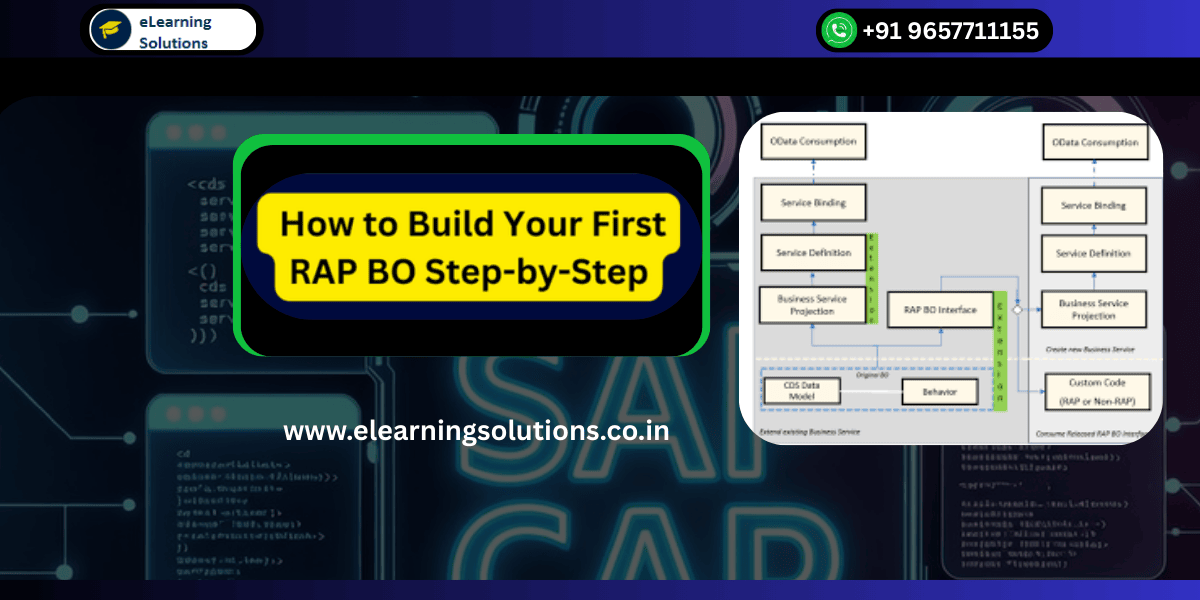
Developing applications using SAP’s RAP (RESTful ABAP Programming Model) is one of the most in-demand skills for ABAP developers in 2026. Whether you are transitioning from traditional ABAP, learning RAP for the first time, or working insideS/4HANA or Steampunk environments, understanding how to build RAP BO is essential. But for beginners, the process often feels intimidating.
In this guide, we’ll break everything down in the simplest way possible—no complex jargon—just a clear, structured, step-based journey that explains exactly how to build your first RAP Business Object (BO) from scratch.
By the end, you will understand how RAP works, why it is important, and how all pieces—CDS, behaviors, handlers, and service bindings—fit together smoothly.
Understanding RAP and Business Objects
Before building your first RAP BO, it’s important to understand what a Business Object really is.
A Business Object (BO) in RAP represents a real business entity—such as a Customer, Order, Project, or Product.
RAP then gives you a modern framework to define:
- Data model (CDS views)
- Business behavior (create/update/delete, validations, determinations)
- UI/Service exposure (Fiori, OData V4)
When you build RAP BO, you are essentially designing:
- What the data looks like
- What operations it supports
- How it behaves in real business scenarios
This shift to BO-centric development makes your applications consistent, scalable, and future-ready for Fiori apps and cloud-first architectures.
Step 1: Create the Database Table
Every RAP BO starts with persistent data.
Example fields:
- OrderID
- CustomerName
- OrderDate
- Status
This table forms the foundation of your Business Object. A well-designed table ensures clean behavior and simple CDS modeling.
Real-world tip:
Use meaningful data types and enable UUID keys for cloud-ready applications.
Step 2: Create the CDS Root View Entity
A Root View Entity represents the top-level node of your RAP BO—like the parent object.
Here’s what you define:
- Key fields
- Associations
- Field types
- Semantic annotations
In a simple model, this is your basic RAP data structure. It’s also the entry point for your behavior definitions.
When learning how to build RAP BO, this step is crucial because it defines how the application “sees” your BO.
Step 3: Create Child View Entities (If Needed)
Not all BOs require nodes, but real business entities often do.
Example:
Sales Order (root) → Sales Items (child)
For each child node, define:
- Keys
- Foreign key associations
- Cardinality
- Navigation paths
Using nodes makes your BO fully scalable, especially for enterprise-grade projects.
Step 4: Define Behavior Using Behavior Definition (BDEF)
This is where RAP becomes powerful.
You define what your BO can do:
- Create
- Update
- Delete
- Actions (e.g., Approve, Reject)
- Validations (e.g., Quantity must be > 0)
- Determinations (e.g., Auto-set status on creation)
A simple behavior definition may look like:
define behavior for Z_I_Order
persistent table ZORDER
{
create;
update;
delete;
action ApproveOrder result [1] $self;
}
In this step, you transform your static data model into a dynamic business object.
Step 5: Implement Behavior Logic in the Behavior Handler
The Behavior Handler class contains the implementation of your BO’s business logic.
This is where:
- Validations run
- Determinations trigger
- Actions execute
- Messages are raised
Example:
When creating an order, you may automatically set:
Status = ‘NEW’
When approving an order:
Status = ‘APPROVED’
This ensures your RAP BO behaves consistently across all applications.
Step 6: Create a Projection View for External Consumers
Projection Views expose only the fields needed for UI or API.
For example:
- Hide technical fields
- Only show user-relevant columns
- Add annotations for Fiori
This creates a clean, UI-ready model using only essential data elements.
Step 7: Define Projection Behavior
Just like the root behavior, your projection needs its own BDEF.
This defines:
- Which operations are exposed externally
- What actions are visible
- What behavior consumers can use
Example:
use root Z_I_Order {
create;
update;
delete;
action ApproveOrder;
}
This step controls what front-end apps or external systems are allowed to do.
Step 8: Build an OData V4 Service Binding
The service binding publishes your RAP BO as an API or UI service.
You define:
- Entity sets
- Authorizations
- UI annotations
- OData protocols
Once activated, you instantly get:
- OData API
- Preview Fiori app
- API Explorer access
This is the exciting moment when your RAP BO becomes usable.
Step 9: Test Your RAP BO with the Fiori Preview
RAP automatically generates a Fiori Elements preview app.
You can test:
- Create
- Update
- Delete
- Actions
- Validations
This step helps beginners understand the full workflow because everything works out-of-the-box.
Step 10: Deploy, Enhance, and Iterate
Once your BO works:
- Add deeper validations
- Introduce workflows
- Optimize performance
- Add value helps
- Support multiple nodes
Building RAP BO is not a one-time activity—it evolves as your business requirements grow.
Why RAP BO Development Matters in 2026
The shift toward cloud-native development in SAP means:
- Steampunk
- BTP ABAP Environment
- S/4HANA Cloud
- Embedded Steampunk
All rely heavily on RAP.
Companies now prefer BO-driven architecture because it brings:
- Clean separation of concerns
- Standardized APIs
- Automatic UI generation
- Faster development cycles
- Cloud readiness
For beginners, learning how to build RAP BO is the fastest way to stay relevant in modern ABAP development.
Conclusion: Start Building Your First RAP BO Today
Building your first RAP BO is easier than it seems.
Once you understand the flow—table → CDS → behavior → handler → projection → service—you can build scalable, modern, cloud-ready applications with confidence.
If you want to continue learning RAP or grow your ABAP cloud skills, explore:
👉 RAP tutorials
👉 ABAP RESTful training programs
👉 Fiori Elements & OData V4 guides
The future of ABAP development is here. Start building it today.
It might be helpful for you:
Which Type of Full-Stack Developer is Best for Beginners?
Exploring the Rapid Application Development Model: Speed
vc_row]




 WhatsApp us