Choosing the right SAP module is arguably the most critical decision for anyone starting a career in this ecosystem, and it is a decision that hinges more on logic than luck. The SAP landscape is vast, and each week, countless aspirants find themselves paralyzed by the same question: “I want to learn SAP, but which module should I choose?” The simple truth is that your success depends on aligning your choice with your professional background, personal interests, and the type of work you find fulfilling. Many people dive into learning a module that does not fit, only to become frustrated and discontinue after a few months.
This comprehensive guide is designed to demystify the SAP module selection process, providing you with the clarity needed to start your career on the right foot. We will explore the functional and technical sides of SAP, break down the most popular modules, and provide a logical framework to help you make an informed choice in 2026. As you begin this journey, it’s also important to consider the quality of training you receive, as the right institute can make all the difference in building your foundational knowledge and landing your first job .
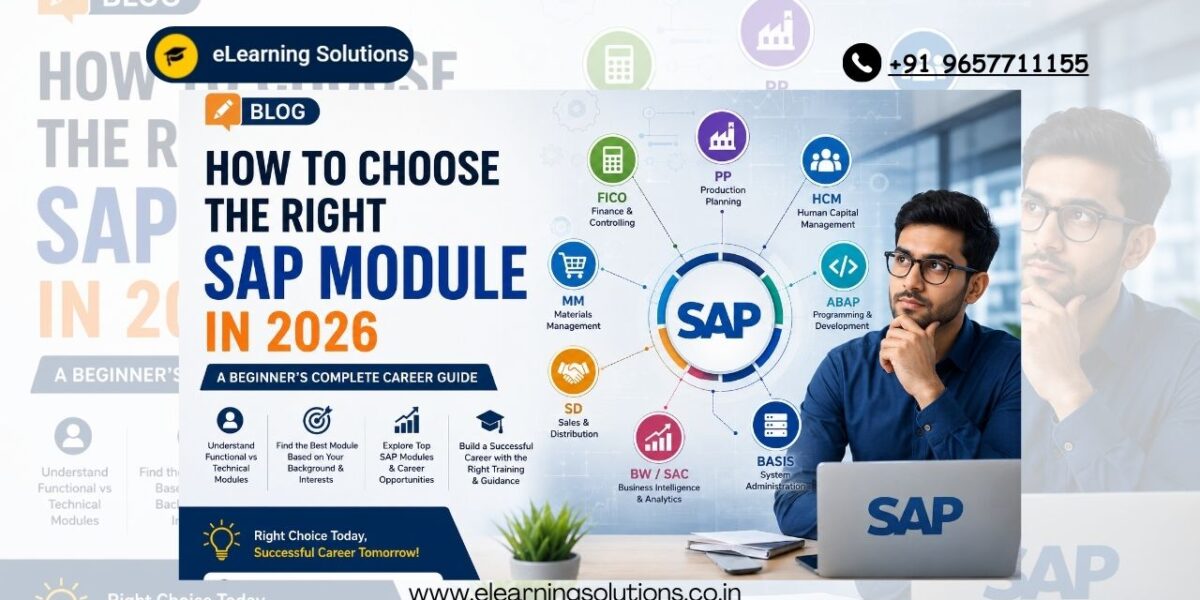
The first step in choosing a module is understanding that SAP modules are broadly classified into two main categories: Functional and Technical. This distinction is fundamental to your decision. Functional modules are business-facing and focus on how companies actually run their operations. They map business processes in areas like finance, materials management, sales, production, and human resources. If you enjoy business logic, operations, and understanding how different departments work together, a functional module is likely your path. Conversely, technical modules are system-facing, focusing on how the software itself works. This involves building, configuring, extending, and managing the SAP environment. If you are a natural problem-solver who loves coding, data, and system architecture, a technical module will be more appealing. Understanding this dichotomy is the first step in filtering your options.
Among the functional modules, Finance and Controlling, often referred to as FICO, stands as one of the most popular and fundamental areas of expertise. The Financial Accounting component manages all financial transactions within an organization, handling accounts payable and receivable, general ledger, asset accounting, and ensuring regulatory compliance. On the other hand, Controlling is for those who love cost analysis, profitability analysis, and internal reporting. It supports the coordination and optimization of all processes, helping businesses make strategic decisions based on internal cost management. If your background is in commerce, accounting, or finance, FICO is a natural and highly rewarding fit. The FICO module helps organizations manage the financial operations of their business, tracking asset accounting, and controlling costs to meet regulatory requirements and support strategic decision-making. This module is an excellent choice for CAs, CIMAs, ACCAs, and CPAs. A comprehensive SAP FICO course will cover key concepts like general ledger accounting, accounts receivable, accounts payable, asset accounting, cost center accounting, and profit center accounting, providing you with the skills to manage financial processes effectively .
For those with a background in supply chain or operations, the Materials Management module is a top choice. This module is responsible for both purchasing and inventory management, helping organizations monitor the purchasing process, maintain accurate stock counts, and minimize stock shortages. It ensures that materials are always available in the supply chain and manages material costs efficiently. It directly links the purchasing process to warehouse inventory and is essential for any manufacturing or distribution firm. As a beginner, you can start by learning SAP MM fundamentals, including procurement basics, the procure-to-pay cycle, purchase orders, goods receipt, and inventory. If you have experience in procurement, logistics, or supply chain management, MM is an ideal module to consider.
Closely related to MM is Sales and Distribution, a module designed for those with a background in sales, marketing, or customer operations. SD manages the sales order process from its inception all the way through to delivery, invoicing, and post-sale customer service. It also includes features like the sales order fulfillment cockpit, intelligent product proposals, and effective returns management. It handles the entire order-to-cash cycle, ensuring timely delivery and accurate payment processing. If you enjoy optimizing sales processes and interacting with customers, SD offers a clear and rewarding career path.
The manufacturing and engineering segment is served by modules like Production Planning and Plant Maintenance. Production Planning is critical for manufacturers and supports manufacturing operations by helping plan production schedules, allocate resources, manage capacity, and monitor workflow. It ensures production targets are met efficiently and integrates with inventory and finance modules. This module deals with the production process including capacity planning, master production scheduling, and material requirement planning, making it a great fit for those interested in the manufacturing department . It is particularly suitable for mechanical or production engineers. Plant Maintenance, meanwhile, focuses on the preventive and predictive maintenance of company assets, enabling companies to maintain production facilities in optimum condition through timely planning and maintenance schedules. It is a fantastic choice for mechanical or maintenance engineers who want to ensure the reliability and longevity of critical infrastructure.
For those with a passion for managing and developing people, Human Capital Management is the clear winner. This module provides a set of tools to manage employees from hire to retire, encompassing recruiting, payroll, performance management, and employee development. It helps businesses manage their most valuable asset efficiently and assists with compliance and employee engagement. Modern HCM also includes cloud-based solutions like SuccessFactors for strategic workforce management, making it a highly future-proof module. If your background is in human resources, HCM offers a direct and powerful way to leverage SAP in your career.
If you find yourself more drawn to the technical side of SAP, the possibilities are equally compelling. Advanced Business Application Programming is the core programming language used within SAP to build business applications and develop custom solutions, integrations, and reports. If you have a computer science background or enjoy programming and logic building, ABAP is a foundational skill that will always be in high demand. It allows you to create the features that functional consultants use to run their businesses. A structured SAP ABAP course will start from the absolute basics, covering ABAP reports, OOPS ABAP, ALV Grid, BAPIs, BADIs, SmartForms, and SAP Fiori, and is designed to make even beginners with no programming background comfortable with the language .
For those more interested in IT infrastructure, the BASIS module is the ideal choice. BASIS is the technical backbone of SAP, responsible for system administration, security, installation, configuration, and database management. BASIS professionals ensure that the SAP environment runs smoothly, securely, and efficiently. If you enjoy networking, system management, and ensuring business continuity, BASIS is a critical and rewarding specialization.
Beyond these traditional modules, the modern SAP landscape offers exciting opportunities in analytics and integration. For data-driven individuals, SAP Business Warehouse and SAP Analytics Cloud are powerful choices. These modules focus on data warehousing, business intelligence, and analytics, providing real-time insights that drive informed decision-making. As businesses increasingly rely on data, specialists in analytics are becoming indispensable. Similarly, integration specialists who connect SAP with other systems through SAP Integration Suite are vital for companies operating a hybrid IT environment.
The process of making your final decision should be a structured self-assessment. First, understand your background and interests. What is your educational qualification? What domain experience do you have? Have you worked in sales, finance, IT, or HR? Your past experience is the best indicator of where you will excel. Next, consider your career goals. What kind of work do you see yourself doing five years from now? Do you want to be a business process consultant, a project manager, or a technical architect? Technical roles often command higher salaries initially, but both paths offer exceptional long-term growth.
Research is also essential. Read about how each module operates in real businesses. Watch videos, read case studies, and explore articles to get a sense of the day-to-day work. It is also wise to talk to a counselor or mentor to shortlist a few modules that suit you. They can help you filter your options and build a specific learning roadmap. A structured learning roadmap is vital, and you can start with foundational knowledge of ERP and a basic understanding of SAP S/4HANA. Begin with a module that aligns with your current skill set. Practical experience is crucial, as SAP cannot be learned through theory alone; you need hands-on practice in sandbox environments. Choosing a training provider that offers real-time project training, industry expert instructors, and hands-on lab access can be invaluable for gaining this practical experience .
A common concern for beginners is that SAP seems too complex. The system has its own rules, processes, and terminology, which can be overwhelming at first. However, because all modules are integrated in real time, you do not need to understand all of them at once. You can begin by learning the one most critical to your role and progressively learn more as you become more confident. The evolution to SAP S/4HANA and cloud-based solutions means what you learn today must be updated, so staying open to continuous learning is key to career longevity. The integration between modules is a key strength; for instance, FICO configuration requires knowledge of data from MM and SD, so understanding these dependencies makes you a more valuable consultant.
In conclusion, there is no single “best” SAP module for beginners. There is only the module that is best for you. The key is to choose a path that aligns with your educational background, professional experience, and interests. By logically assessing your strengths and focusing on a module that fits your natural inclinations, you will build a rewarding career in SAP. To give your career the right start, consider institutions like eLearning Solutions, which has been a leading technology training provider in the SAP and Oracle space since 2014, offering online and classroom training with strong placement assistance . Their focus on job-oriented training, experienced faculty, and practical exposure can bridge the gap between theory and the real-world skills employers are looking for . The modules are all interconnected, so whatever you choose, you will be part of a dynamic ecosystem that drives some of the world’s most successful businesses.
YOU MAY BE INTERESTED IN
ABAP Evolution: From Monolithic Masterpieces to Agile Architects
A to Z of OLE Excel in ABAP 7.4




 WhatsApp us