

A data model in a database management system (DBMS) is the concept of tools designed to summarize the description of the database. Building a true database is made easier with the help of data models, which provide a clear perspective of the data. It leads us from the design of the data to the proper use of it.
Types of Relational Models
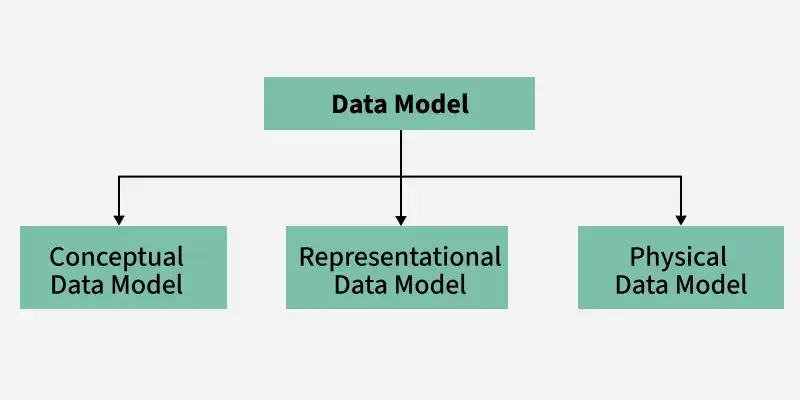
- Conceptual Data Model
- Representational Data Model
- Physical Data Model
It is basically classified into 3 types:-
Data Models
1. Conceptual Data Model
The conceptual data model offers a high-level description of the database, which facilitates comprehension of its demands and requirements. Before database designers start building a particular database, this paradigm is used during the requirement-gathering stage. One such popular model is the entity/relationship model (ER model). The E/R model, which emphasizes entities, relationships, and even attributes, is used by database designers. This concept can be discussed with stakeholders and consumers who are not technical (i.e., do not have a background in computer science), and their needs can be identified.
Entity-Relationship Model( ER Model): It is a high-level data model which is used to define the data and the relationships between them. It is basically a conceptual design of any database which is easy to design the view of data.
Components of ER Model:
- Entity: A real-world thing is referred to as an entity. It could be a class, name, location, or item. In an ER Diagram, these are shown by a rectangle.
- Attribute: An attribute is a description of an entity. In an ER diagram, these are shown by an ellipse. It could be a student’s age, roll number, or grades.
- Relationship: Relationships define the connections between various entities. Relationships are represented by rhombuses and diamonds.
Characteristics of a conceptual data model
- provides coverage of the business ideas for the entire organization.
- Data models of this kind are created with a corporate audience in mind.
- The conceptual model is created independently of software specifications, such as DBMS vendor and technology, or hardware specifications, such as data storage capacity and location. Representing data as a user would perceive it in the “real world” is the main goal.
By defining fundamental concepts and scope, conceptual data models called domain models give all stakeholders a shared language.
2. Representational Data Model
This type of data model only represents the logical part of the database; it does not describe the physical structure. The representational data paradigm allows us to focus primarily on the database design. One popular kind of representational model is the relational model. The relational paradigm consists of Relational Calculus and Relational Algebra. In essence, the Relational Model uses tables to show our data and the relationships between them. Physical data models are used to implement this theoretical concept.
The benefit of employing a representational data model is that it offers a basis upon which the physical model may be built.
Characteristics of Representational Data Model
- represents the database’s logical structure.
- Relational models, such as Relational Calculus and Relational Algebra, are frequently employed.
- represents facts and relationships using tables.
- lays the groundwork for constructing the actual data model.
3. Physical Data Model
The physical data model is used to physically execute relational data models. Ultimately, all of the data in a database is stored on secondary storage media, such as CDs and tapes. This is stored in files, records, and several other types of data structures. It contains all of the details on the file type, database structure, presence of other data structures, and their connections. In this instance, tables are essentially stored in RAM for efficient access. To create a good physical model, the relational model must be enhanced. Structured Query Language (SQL) is used to implement relational algebra in a realistic manner.
This Data Model describes HOW the system will be implemented using a specific DBMS system. This model is typically created by DBA and developers. The purpose is actual implementation of the database.
Characteristics of a physical data model:
- Depending on the scope of the project, the physical data model may be combined with other physical data models, but it explains the data requirements for a specific project or application.
- Relationships between tables that handle cardinality and nullability are included in the data model.
- created for a certain DBMS version, site, data storage system, or technology that will be employed in the project.
- Columns should contain default values, given lengths, and precise datatypes.
- Views, indexes, access profiles, authorizations, primary and foreign keys, and more are defined.
Some Other Data Models
1. Hierarchical Model
The hierarchical model, developed by IBM in the 1950s, is among the first data models. Data can be viewed as segments that comprise a hierarchical relation or as a collection of tables in a hierarchical model. In this structure, each record contains many children and a parent record, arranging the data in a tree-like fashion. The segments may be linked rationally to form a chain-like structure, but the immediate structure may be a fan structure with multiple branches. Directed associations are the term used to describe the illogical associations.
2. Network Model
In the 1960s, the Database Task group developed the Network Model. The hierarchical model is generalized in this model. There is a logical connection between the segments that belong to each level, even if this model may have several parent segments that are grouped as levels. Most of the time, any two segments have a reasonable many-to-many relationship.
3. Object-Oriented Data Model
In the object-oriented data model, the single element that contains the data and its relationships is referred to as an object. Here, real-world problems are portrayed as objects with different attributes. There are numerous connections between every object and other ones. It basically blends object-oriented programming with a relational database paradigm.
4. Float Data Model
The float data model basically consists of a two-dimensional array of data models that do not contain any duplicate elements in the array. This data model has one drawback it cannot store a large amount of data that is the tables can not be of large size.
5. Context Data Model
The Context data model is, in short, a data model made up of several data models. For example, the Object-Oriented Data Model, ER Model, and others are part of the Context data model. Compared to other data models, users can achieve more with this one.
6. Semi-Structured Data Model
Semi-Structured data models deal with the data in a flexible way. Some entities may have extra attributes and some entities may have some missing attributes. Basically, you can represent data here in a flexible way.
Advantages of Data Models
- Accurate data representation is made possible by data models.
- It assists us in reducing data redundancy and locating missing data.
- Data security is better provided by Data Model.
- The data model need to be sufficiently comprehensive to be utilized in the construction of the actual database.
- Table relationships, primary and foreign keys, and stored procedures can all be defined using the data model’s metadata.
Disadvantages of Data Models
- It can occasionally be challenging to comprehend the data model when dealing with large databases.
- To use physical models, you need to be well knowledgeable about SQL.
- Modifications to the entire application are necessary for even minor structural changes.
- DBMSs don’t have a standard language for data manipulation.
- One must be aware of the physical properties of the data being stored in order to create a data model.
Conclusion
In conclusion, data modeling is a crucial database architecture stage that ensures accuracy, consistency, and quality in data management and storage. Using conceptual, logical, and physical models, it establishes a structured framework for specifying entities, relationships, and implementation details. Data modeling can be challenging since structural changes impact the entire application, even while it ensures data integrity and encourages better organization. Despite its drawbacks, data modeling is essential to creating database systems that are scalable, reliable, and efficient.
It might be helpful:
What is Backend Development? A Complete Guide for Beginners [2025]
What is a database? Definition, Types, Uses, Advantages -2024


 WhatsApp us