
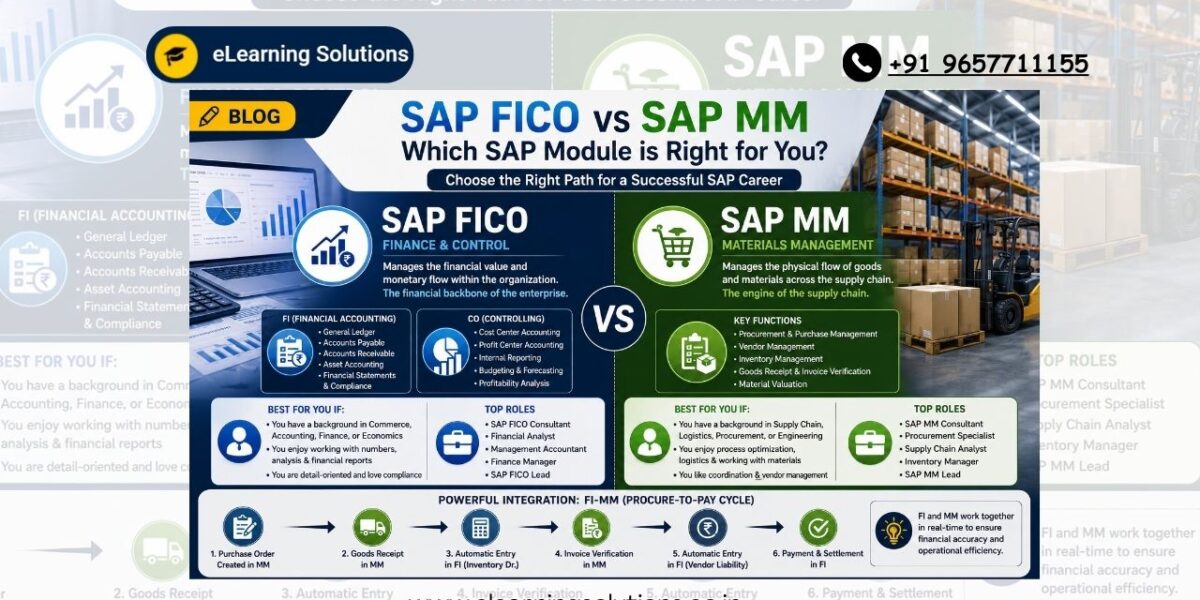
Choosing between SAP FICO and SAP MM is one of the most common dilemmas for SAP aspirants, and rightly so, because both are powerhouse modules that offer incredible career opportunities. However, they cater to entirely different skill sets and professional interests. SAP FICO, which stands for Financial Accounting and Controlling, is the financial backbone of the enterprise, while SAP MM, or Materials Management, is the engine of the supply chain . Understanding their core differences is the first and most crucial step in making a career choice that you will be happy with for years to come.
The fundamental distinction lies in their core focus. SAP FICO is all about managing the financial value and the monetary flow within a company. It ensures that every financial transaction is recorded accurately, reports are generated for compliance, and the organization’s financial health is meticulously tracked . The FI (Financial Accounting) component handles external accounting, managing the general ledger, accounts payable, and accounts receivable for statutory reporting. The CO (Controlling) component, on the other hand, is for internal management, dealing with cost centers, profit centers, and profitability analysis to help businesses make informed strategic decisions . If you have a knack for numbers, compliance, and analytical thinking, and enjoy ensuring financial integrity, FICO is your natural home .
Conversely, SAP MM is concerned with the physical flow of goods and materials. It is the module that manages the entire procurement and inventory lifecycle, from identifying a need for materials, sourcing vendors, and creating purchase orders, to managing inventory levels, handling goods receipt, and verifying invoices . Think of it as the module that ensures the right materials are available at the right time, in the right quantity, and at the right price . MM is the go-to module for professionals fascinated by process optimization, logistics, and the tangible flow of products through the supply chain . It integrates heavily with procurement, warehouse, and production planning teams to ensure a seamless flow of information and materials .
This difference in focus also dictates the typical user roles and responsibilities. A SAP FICO consultant is a finance expert, working closely with accountants, financial analysts, and controllers . Their daily tasks involve managing financial data, generating financial reports like balance sheets and P&L statements, executing financial analysis, and ensuring compliance with accounting standards like GAAP or IFRS . The work is deeply analytical and focused on reporting, budgeting, and forecasting . On the other hand, a SAP MM consultant is a supply chain and procurement specialist. They work with procurement teams, warehouse managers, and production planners to create and manage purchase orders, build strong vendor relationships, optimize inventory to prevent stockouts or surplus, and expedite the entire procurement cycle .
Despite their different domains, these two modules are not isolated; in fact, they are deeply integrated in a real-time SAP environment. The integration between FI and MM is one of the most critical and common cross-functional integrations, often referred to as the FI-MM integration or the Procure-to-Pay (P2P) cycle . This ensures that every material movement in MM automatically triggers a corresponding financial entry in FICO. For example, when a goods receipt is posted in MM, the system automatically debits the inventory account and credits the GR/IR clearing account in FI . When the vendor invoice is later verified in MM, the GR/IR account is cleared, and the vendor liability is recorded in FI . This seamless integration ensures that the financial books always reflect the physical state of the inventory, providing a single source of truth for the entire organization . Understanding this integration is crucial for any SAP professional, as it demonstrates how the modules work together to support core business processes .
Given these differences, how do you choose which path is right for you? The decision ultimately comes down to your personal interests and professional background. Ask yourself: Do you manage the physical flow of materials (MM), or do you manage the financial flow of value that this movement creates (FICO)? If your background is in commerce, accounting, finance, or economics, and you enjoy working with data, spreadsheets, and financial reports, SAP FICO is the clear choice . It is a stable, high-paying career path with opportunities across every industry sector, from banking to manufacturing . If you have a background in supply chain management, logistics, procurement, or industrial engineering, and you enjoy optimizing processes and working with tangible goods, then SAP MM is your ideal path . Both modules are in high demand, and mastering either one can lead to a highly rewarding career, especially when combined with S/4HANA knowledge . The best choice is the one that aligns with your natural strengths and the type of work you find most fulfilling.
YOU MAY BE INTERESTED IN
How to Convert JSON Data Structure to ABAP Structure without ABAP Code or SE11?
ABAP Evolution: From Monolithic Masterpiece




 WhatsApp us