

Building a SaaS product has become one of the most exciting opportunities in modern software development. Whether you’re a beginner, a startup founder, or a professional engineer, understanding how to build a multi-tenant SaaS with Next.js and Prisma is a powerful skill that opens the door to scalable, profitable platforms.
In today’s world, businesses expect cloud-native applications that can serve multiple customers (tenants) while keeping data secure, performance high, and costs low. Multi-tenancy makes this possible by allowing a single application to serve many customers without deploying separate codebases.
In this guide, you’ll explore what multi-tenancy means, why Next.js and Prisma are a perfect pair for SaaS development, and how to architect a modern, scalable multi-tenant platform.
Understanding Multi-Tenancy in Simple Terms
Before diving deep, let’s simplify the concept:
Multi-tenancy means one application serving multiple customers, where each customer is a tenant. Tenants may be:
- Companies
- Teams
- Users
- Organizations
Each tenant has its own data and settings, but all tenants share:
- The same codebase
- The same deployed environment
- The same infrastructure
Think of tools like:
- Slack
- Shopify
- Notion
- HubSpot
These are multi-tenant SaaS platforms used by millions of users simultaneously—but everyone sees their own data.
The biggest challenge? Isolating tenant data while keeping everything fast and secure.
That’s where Next.js and Prisma shine.
Why Next.js Is Ideal for Multi-Tenant SaaS
Next.js provides the perfect foundation for building SaaS platforms because it offers:
1. Full-stack Capabilities
API routes + React frontend → all in one framework.
2. Dynamic Routing for Tenant URLs
Support for:
- companyA.yourapp.com
- yourapp.com/companyA
- app.companyA.com (with middleware)
3. Middleware for Authentication
Tenant-aware authentication is a must for SaaS apps.
4. Server Components and App Router
Efficient rendering keeps apps fast and scalable.
5. Flexibility for Any Architecture
Supports edge functions, serverless, or dedicated servers.
Why Prisma Is the Best Match for Multi-Tenant Databases
Prisma makes database queries safe, fast, and structured for multi-tenant logic.
Benefits include:
1. Type-Safe Queries
Reduces bugs when handling tenant-based filtering.
2. Supports All Major Databases
PostgreSQL (most common for SaaS), MySQL, SQL Server, SQLite.
3. Easy Implementation of Tenant Isolation Patterns
You can choose between:
A. Single Database, Shared Schema (Row-Level Multi-Tenancy)
Every row includes tenantId.
B. Single Database, Multiple Schemas (Schema Multi-Tenancy)
Each tenant gets a schema: tenantA.users, tenantB.users.
C. Multiple Databases (Database Multi-Tenancy)
For enterprise-grade isolation.
Prisma supports all three patterns.
Choosing the Right Multi-Tenancy Model
Let’s break it down without jargon:
1. Row-Level Multi-Tenancy (Most Popular)
Use when:
- You want to scale easily
- You prefer lower cost
- Tenants are small to medium-sized
You store tenantId on every table:
id | name | tenantId
Prisma makes filtering simple:
prisma.user.findMany({
where: { tenantId: currentTenantId },
});
2. Schema-Level Multi-Tenancy
Use when:
- Tenants need isolated configurations
- You want better organization
- You’re expecting larger data volume
Each tenant has tables in separate schemas.
3. Database-Level Multi-Tenancy
Use when:
- Customers require strict isolation (e.g., finance, healthcare)
- You support enterprise clients
- Compliance requires separation
This is the most expensive and complex.
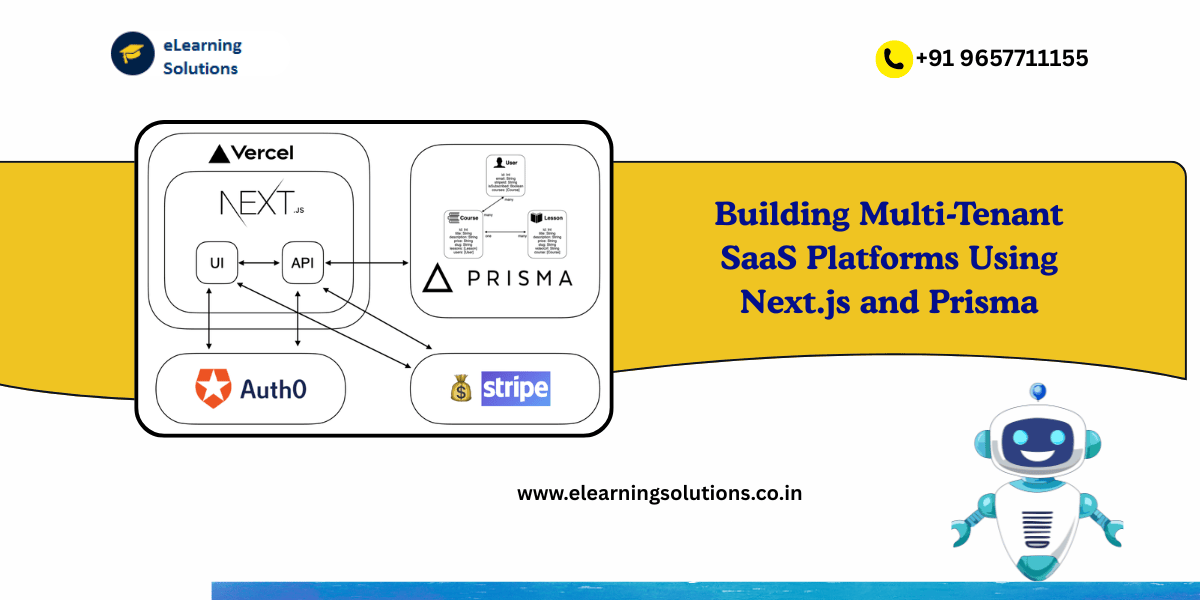
Building a Multi-Tenant SaaS: High-Level Architecture
Here’s the modern architecture used by SaaS companies:
Frontend (Next.js)
- Tenant-aware routing
- Authentication middleware
- Dashboards and forms
Backend (Next.js API Routes or Server Actions)
- Protect endpoints
- Resolve current tenant
- Apply tenantId to queries
Database (Postgres + Prisma)
- Implement tenant isolation
- Efficient indexing
- Role-based Access Control
Authentication (Clerk, Auth.js, Supabase, Cognito)
- Sign in / sign up
- Map users to organizations
- Manage roles (Admin, Member, Viewer)
Deployment (Vercel, Railway, AWS, Render)
- Serverless scaling
- Global routing
- CDN caching
Step-by-Step: How Beginners Can Start Building Multi-Tenant SaaS
Here is a simple workflow.
Step 1: Create a Next.js App
npx create-next-app saas-platform
Step 2: Install Prisma
npm install prisma –save-dev
npx prisma init
Step 3: Design the Database Schema
Example row-level schema:
model Tenant {
id String @id @default(cuid())
name String
users User[]
}
model User {
id String @id @default(cuid())
email String @unique
tenantId String
tenant Tenant @relation(fields: [tenantId], references: [id])
}
Step 4: Add Middleware for Tenant Resolution
Use Next.js middleware to detect tenant from subdomain or path.
Step 5: Implement Tenant-Aware Queries
Example:
const data = await prisma.project.findMany({
where: { tenantId },
});
Step 6: Create Dashboards for Each Tenant
Users see only their own data.
Step 7: Deploy and Scale
Use Vercel or cloud providers.
Real-World Use Cases for Multi-Tenant SaaS with Next.js & Prisma
1. Project Management Platforms
Separate dashboards for companies.
2. CRM and Sales Tools
Each business sees its leads and deals.
3. E-Commerce Platforms
Shopify-style multi-store architecture.
4. Learning Management Systems (LMS)
Different organizations manage courses.
5. HR & Payroll Systems
Complete data privacy per client.
Industry Trends for 2026 and Beyond
1. Full Serverless SaaS Architectures
Next.js + PlanetScale + Neon.
2. AI-Powered SaaS
Integrating AI copilots and assistants inside dashboards.
3. Dynamic Pricing Models
Pay-per-tenant or usage-based billing.
4. Edge Deployment
Faster performance globally.
5. Tenant-Theming and Customization
Let companies personalize their workspace.
Conclusion: Your SaaS Journey Starts Here
Building a multi-tenant SaaS with Next.js and Prisma is not only achievable but incredibly powerful. With the right architecture and mindset, you can create platforms that scale to thousands of tenants, deliver secure and isolated data, and evolve into profitable SaaS businesses.
If you’re ready to go deeper, explore our tutorials, hands-on guides, and training courses to master SaaS development with modern full-stack technologies.
It might be helpful for you:
Which Type of Full-Stack Developer is Best for Beginners?
Exploring the Rapid Application Development Model: Speed


 WhatsApp us