
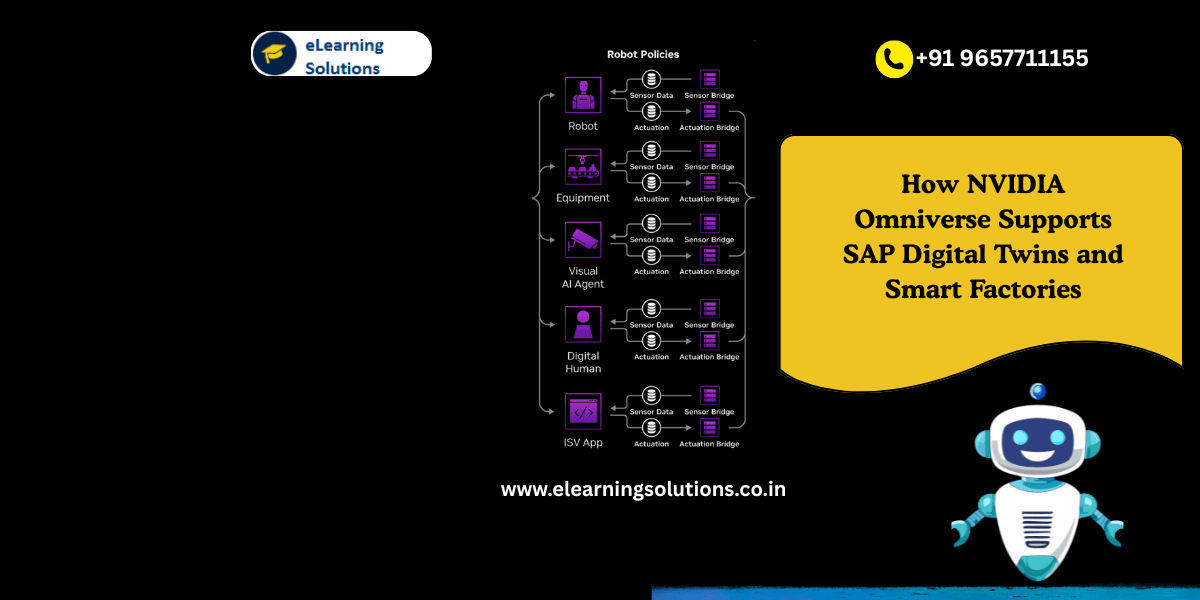
The concept of digital twins is transforming the way industries design, manufacture, and maintain products. With Industry 4.0 pushing the boundaries of automation, data integration, and smart manufacturing, technologies like NVIDIA Omniverse and SAP Digital Twins are working hand-in-hand to redefine industrial innovation. This partnership is bridging the gap between the physical and digital worlds, enabling enterprises to visualize, simulate, and optimize complex factory operations in real time. For full-stack developers, data engineers, and enterprise architects, understanding how NVIDIA Omniverse supports SAP Digital Twins is key to unlocking the next generation of intelligent manufacturing.
Reimagining Manufacturing Through Digital Twins
A digital twin is a virtual representation of a physical object, process, or system that updates in real time based on data from sensors, IoT devices, and enterprise systems. SAP Digital Twins are designed to create this bridge between operational and business data, providing a unified view of assets and processes. However, visualization and simulation are critical to make these twins actionable. That’s where NVIDIA Omniverse steps in, offering a collaborative, physically accurate, and AI-powered simulation platform that gives life to SAP’s data-driven twins. With Omniverse, teams can simulate everything—from production line behavior to energy efficiency—before making changes in the real world.
The Role of NVIDIA Omniverse in Smart Factory Transformation
NVIDIA Omniverse serves as a scalable, real-time 3D collaboration and simulation platform built on Universal Scene Description (USD). It enables engineers, designers, and developers to work together seamlessly across different software tools and 3D applications. In the context of SAP Digital Twins, Omniverse becomes the visualization and simulation layer that translates SAP’s enterprise data into dynamic, interactive environments. Imagine factory managers being able to view live equipment status, production throughput, and maintenance predictions—all visualized in a digital replica of their facility. This integration is not just about better visualization; it’s about creating a smarter, safer, and more efficient manufacturing ecosystem.
Bringing Data to Life with SAP and Omniverse Integration
One of the biggest challenges in industrial innovation is data silos. SAP’s powerful data management systems, like SAP S/4HANA and SAP Digital Manufacturing Cloud, centralize enterprise data—from production logs to supply chain analytics. NVIDIA Omniverse takes this structured data and visualizes it in a physics-accurate environment. This means every asset in the factory can be represented with real-world behavior. A malfunctioning conveyor belt or temperature fluctuation in a production cell can be simulated and analyzed in Omniverse before it causes downtime in reality. The combination of SAP’s robust data layer and Omniverse’s high-fidelity simulations turns data into a living, visual intelligence framework.
Empowering Collaboration Across the Digital Ecosystem
In modern enterprises, collaboration often spans across multiple departments, partners, and technology systems. NVIDIA Omniverse provides the collaborative backbone that allows SAP Digital Twins to be accessible and interactive across teams. Designers can model factory layouts in Autodesk or Siemens tools, while engineers analyze process efficiency directly from SAP’s operational data—all within Omniverse’s shared 3D environment. This integration not only reduces communication gaps but also enhances decision-making by allowing multiple stakeholders to interact with the same live digital twin simultaneously.
AI-Driven Automation and Predictive Insights
Artificial intelligence plays a crucial role in optimizing digital twin workflows. NVIDIA’s AI technologies—powered by GPUs and frameworks like CUDA and TensorRT—enhance SAP Digital Twins with predictive analytics, anomaly detection, and process optimization. In a smart factory, AI algorithms running on NVIDIA platforms can predict when a machine will fail, analyze energy consumption, or suggest workflow improvements. By feeding these insights back into SAP systems, businesses achieve a closed-loop intelligence cycle: data from operations informs simulation, simulation drives optimization, and optimization enhances operations.
Real-World Use Cases of NVIDIA Omniverse and SAP Digital Twins
Manufacturers like BMW and Siemens have already showcased how digital twins revolutionize production planning and factory design. Using NVIDIA Omniverse, they can simulate assembly lines, worker movements, and robotics coordination in a digital environment before deploying changes on the floor. When combined with SAP’s analytics and process control tools, this creates a live decision-making environment where every change is backed by data. For example, a global electronics manufacturer might use Omniverse to simulate the impact of adding a new robotic arm to a production line, while SAP systems calculate the financial and supply chain implications instantly. This synergy between visualization and business intelligence accelerates innovation while minimizing risks and costs.
The Market Shift Toward Intelligent Manufacturing
Industry analysts predict that the digital twin market will exceed $100 billion by 2030, driven largely by the adoption of AI, IoT, and real-time simulation technologies. SAP and NVIDIA are at the forefront of this transformation, enabling enterprises to evolve from reactive to predictive operations. With sustainability and operational efficiency becoming top priorities, smart factories powered by Omniverse and SAP solutions are helping organizations reduce waste, optimize resources, and maintain continuous improvement. For full-stack developers and architects, this trend represents an exciting opportunity to build integrations that merge real-time data, cloud computing, and immersive visualization technologies.
Building the Future: Steps Toward Integration
For organizations looking to start their journey, the key is to align their SAP ecosystem with digital twin and simulation capabilities. Begin by mapping data sources within SAP S/4HANA, IoT sensors, and manufacturing systems. Then, integrate NVIDIA Omniverse connectors that translate this data into 3D visual environments. Developers can use Omniverse APIs and USD pipelines to customize simulations that reflect real-world factory conditions. The goal is not to replace existing systems but to enhance them—creating a digital foundation where data, design, and decisions co-exist in real time.
Envisioning Tomorrow’s Intelligent Enterprises
The integration of NVIDIA Omniverse and SAP Digital Twins is more than a technological milestone; it’s a glimpse into the future of intelligent enterprises. As the lines between virtual and physical environments blur, businesses gain the ability to test, learn, and adapt faster than ever before. Smart factories powered by this synergy can predict challenges, innovate on the fly, and deliver personalized manufacturing outcomes. For developers, engineers, and business leaders alike, now is the perfect time to explore how this partnership can shape your digital transformation journey.
Explore Further with Us
If you’re inspired by how NVIDIA Omniverse and SAP Digital Twins are redefining smart manufacturing, explore our advanced learning materials and in-depth guides available on our website. Dive deeper into real-time simulation, AI-driven design, and intelligent enterprise solutions that will prepare you for the future of digital innovation.
YOU MAY BE INTERESTED IN
ABAP Evolution: From Monolithic Masterpieces to Agile Architects
A to Z of OLE Excel in ABAP 7.4




 WhatsApp us