
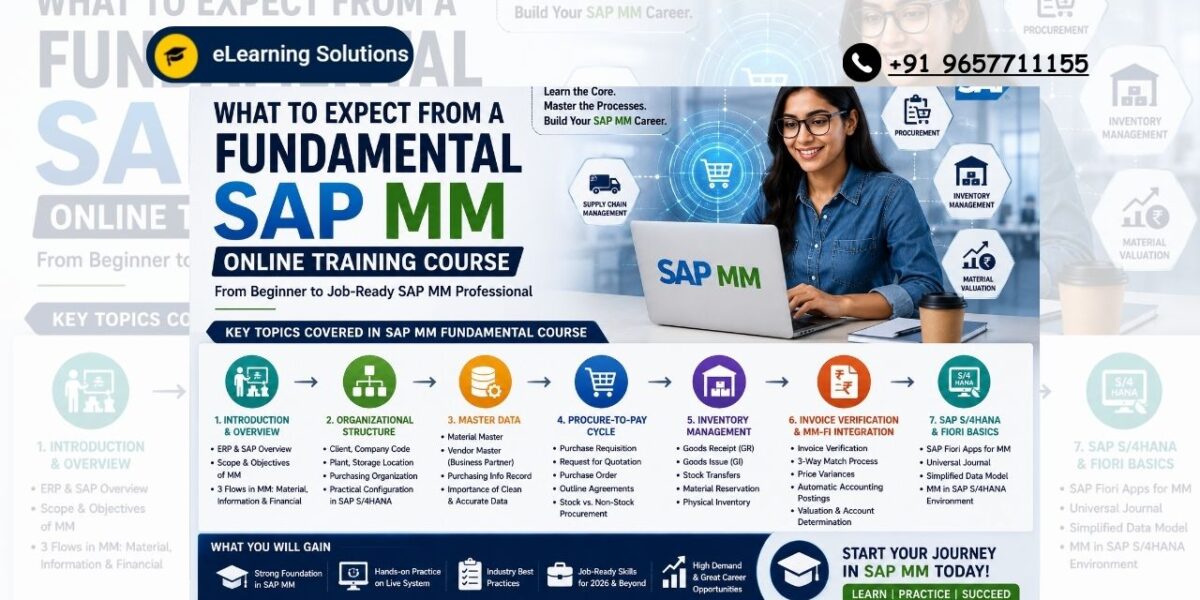
So, you have decided to build a career in one of the most sought-after domains in the enterprise software world: SAP Materials Management. This is a fantastic decision, as the MM module is the logistical backbone of any company that deals with physical goods, which includes manufacturing, retail, and distribution firms. However, before you can start managing global supply chains, you need to build a solid foundation, and the best way to do that is through a comprehensive online training course. But what exactly should you expect from a fundamental SAP MM online training course? The best courses are designed to transform you from a complete beginner into a job-ready professional by taking you through a structured journey across the entire landscape of the module.
The first thing a quality fundamental course will establish is the ‘why’. You will begin by exploring the core concepts of Enterprise Resource Planning and where SAP fits into the modern business world. A good course clearly defines the scope and objectives of the MM module, explaining how it manages procurement, inventory, and material valuation to ensure the right materials are available at the right time, cost, and quantity . It will also give you a high-level overview of the three flows that MM manages: the flow of materials from supplier to customer, the flow of information such as order status, and the financial flow which tracks the value of materials . This foundational understanding is crucial before you ever log into the system, as it provides the business context for everything you will do later.
Once the theory is clear, any effective SAP MM online training will immerse you in the organizational structure of the system. You will learn about the building blocks of an SAP implementation, such as the Client, Company Code, Plant, Storage Location, and Purchasing Organization . This is more than just administrative jargon; it is the framework that dictates how every transaction works. For instance, a purchase order is always assigned to a specific plant and purchasing organization, so understanding how these elements are assigned is fundamental to executing processes correctly . The best courses use practical exercises, often on a live SAP S/4HANA system, to have you create and assign these elements, ensuring you grasp the concept through hands-on action. You will learn the difference between a company code, which represents a legal entity, and a plant, which is a physical or logical location for materials.
With the foundation and structure in place, the course will then dive into the heart of the MM module: Master Data. Master data is the core information that remains consistent across all transactions, and mastering it is non-negotiable for any MM professional. A fundamental course will thoroughly cover the Material Master, which is the central repository for all information about a material or product, including descriptions, units of measure, and valuation data . You will also learn about the Vendor Master (now managed through the Business Partner approach in S/4HANA), which holds all critical information about your suppliers . Finally, you will master the Purchasing Information Record, which links a specific material to a specific vendor and stores agreed-upon conditions like prices . These elements are the data that every single procurement and inventory process relies on, and the course will emphasize why keeping this data accurate is so critical.
The next major pillar of your SAP MM fundamentals course is the complete Procure-to-Pay cycle. This is the lifeblood of the module, and a detailed exploration of this process is what separates a basic course from a good one. You will learn the entire sequence, starting with the creation of a Purchase Requisition, which is an internal request for goods or services generated by a department . From there, you will learn how to determine sources of supply, often by using a Request for Quotation to solicit bids from vendors . Then comes the creation of the formal Purchase Order, which is the legally binding document sent to the supplier . The course will also teach you about other procurement instruments like outline agreements (contracts and scheduling agreements) for long-term purchasing relationships . You will learn the difference between procuring materials for stock, which go into your inventory, and procuring for direct consumption, which are charged directly to a cost center . By the end of this section, you will understand how to move a requirement from need to a legally binding order.
A fundamental course will then guide you through the physical side of the supply chain: Inventory Management. This is where you will learn how goods are received, stored, and moved within the warehouse. You will practice posting Goods Receipts, which increases your stock of a material and triggers the corresponding financial posting . Conversely, you will learn how to post Goods Issues, which reduces stock when materials are used in production or shipped to a customer . You will also be introduced to important concepts like stock transfers between plants, material reservations, and the physical inventory process, which is used to reconcile system stock with what is actually on the warehouse shelves .
The journey concludes with the integration with Finance, which is the final step in the procure-to-pay cycle. A fundamental SAP MM course will teach you about Invoice Verification, a critical control point where you verify that the vendor’s invoice matches the quantities and prices on the purchase order and the goods receipt . You will learn about the three-way match process and how price variances are handled . This is also where you will see the powerful integration between MM and SAP FICO, as the course explains how goods movements automatically post to the general ledger, and how the valuation and account determination are configured . By understanding this integration, you will see how the physical flow of materials translates directly into the financial flow of the company.
Finally, and this is crucial for your career in 2026, a good fundamental SAP MM online training course will not ignore the modern context. You should expect to be introduced to the S/4HANA environment, and specifically, how procurement and inventory management processes are executed using modern SAP Fiori apps . While many courses will still teach you the classic transaction codes, the best ones will show you how to navigate the new, user-friendly Fiori interface. They will introduce you to the concept of the Universal Journal and the simplified data model of S/4HANA . This ensures that the skills you are learning are not only relevant today but are also aligned with the future of SAP, making you a much more attractive candidate to employers.
YOU MAY BE INTERESTED IN
ABAP Evolution: From Monolithic Masterpieces to Agile Architects
A to Z of OLE Excel in ABAP 7.4




 WhatsApp us