
Frontend development has traditionally revolved around HTML, CSS, and JavaScript. While JavaScript has evolved rapidly, modern web applications now demand high performance, complex calculations, and near-native speed.
This is where WebAssembly (WASM) enters the picture.
In this beginner-friendly guide, we’ll explore WebAssembly for frontend developers, why it matters, how it works with JavaScript, and how it’s shaping the future of web development.
What Is WebAssembly (WASM) in Simple Terms?
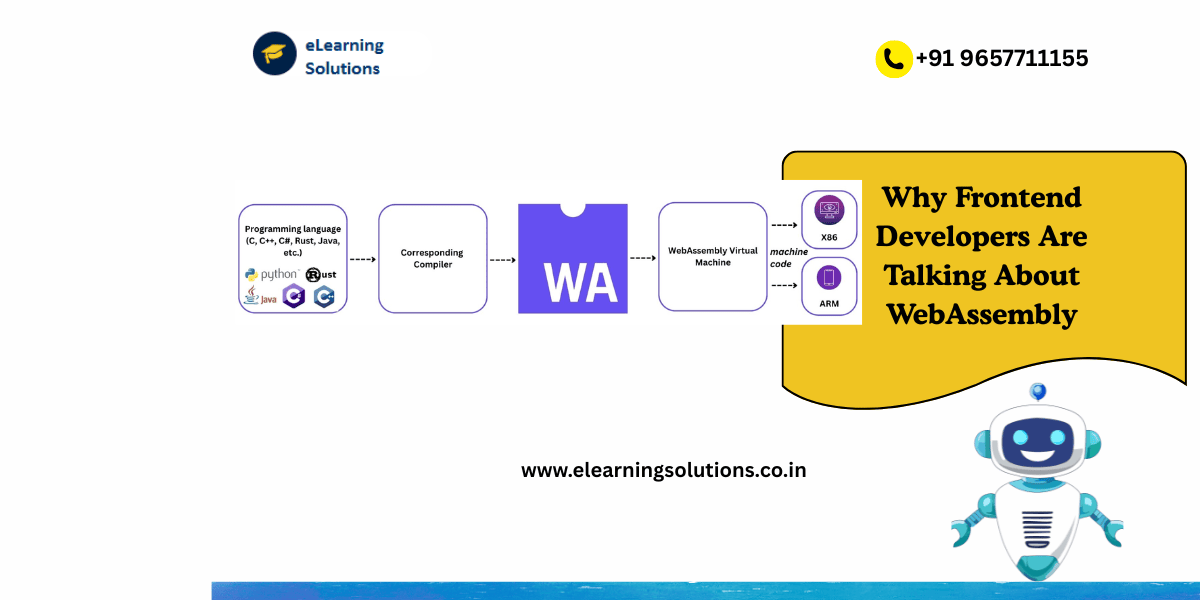
WebAssembly is a low-level binary format that allows code written in languages like C, C++, Rust, and Go to run directly in the browser at near-native speed.
Think of WASM as:
- A performance booster for the web
- A companion to JavaScript, not a replacement
- A way to run heavy logic efficiently in browsers
For frontend developers, WASM opens doors to use cases that were once impractical on the web.
Why WebAssembly Matters for Frontend Developers
JavaScript is flexible, but it isn’t always fast enough for:
- Image processing
- Video editing
- 3D rendering
- Game engines
- AI and ML inference
WebAssembly solves this by:
- Running code faster
- Reducing CPU overhead
- Handling complex logic efficiently
This makes WebAssembly for frontend developers a game-changer.
How WebAssembly Works with JavaScript
A common misconception is that WASM replaces JavaScript. It doesn’t.
Instead:
- JavaScript handles UI, events, and DOM
- WebAssembly handles heavy computation
JavaScript loads and communicates with WASM modules using APIs, making them work together seamlessly.
Real-World Example: Image Processing in the Browser
Imagine building a photo editor:
- Filters
- Cropping
- Color correction
With JavaScript alone, performance can suffer. Using WebAssembly:
- Core image logic runs in WASM
- UI stays in JavaScript
- Performance improves dramatically
This is a common use case of WebAssembly for frontend developers.
Supported Languages for WebAssembly
Frontend developers don’t need to learn assembly language.
Popular WASM-supported languages include:
- Rust (most popular)
- C and C++
- Go
- AssemblyScript (TypeScript-like)
Rust is especially popular due to safety and tooling support.
WebAssembly vs JavaScript: Key Differences
JavaScript:
- High-level
- Easy to write
- Event-driven
WebAssembly:
- Low-level
- Compiled
- Extremely fast
Best practice:
- Use JavaScript for interaction
- Use WASM for performance-critical logic
When Should Frontend Developers Use WebAssembly?
WebAssembly is ideal when:
- Performance is critical
- Heavy calculations are required
- Reusable logic exists in non-JS languages
- You want near-native speed in browsers
It’s not necessary for simple websites or basic CRUD apps.
Common Use Cases of WebAssembly in Frontend Development
Some popular applications include:
- Online IDEs
- Browser-based games
- Video and audio editors
- Data visualization tools
- AI-powered web apps
Companies like Figma, AutoCAD Web, and Google Earth already use WASM.
WebAssembly and Modern Frameworks
WebAssembly works well with:
- React
- Angular
- Vue
- Svelte
Frameworks manage UI, while WASM handles performance-heavy tasks behind the scenes.
WebAssembly in 2026: Industry Trends
Current and upcoming trends include:
- WebGPU + WASM for graphics
- AI inference directly in browsers
- WASM outside the browser (WASI)
- Edge computing with WASM
These trends make WebAssembly for frontend developers a future-proof skill.
Security Benefits of WebAssembly
WebAssembly runs in a secure sandbox:
- No direct memory access
- Strict execution boundaries
- Browser-controlled permissions
This makes it safer than running native code.
Learning Curve for Beginners
Good news for frontend developers:
- You don’t need to master low-level programming immediately
- Start by integrating existing WASM libraries
- Gradually learn Rust or AssemblyScript
The ecosystem is becoming more beginner-friendly each year.
Common Mistakes Beginners Make
Avoid these pitfalls:
- Using WASM for simple tasks
- Expecting WASM to replace JavaScript
- Ignoring bundle size
- Over-optimizing too early
WASM should be used strategically.
WebAssembly vs Web Workers
Web Workers:
- Parallel execution
- Still JavaScript
WebAssembly:
- Faster execution
- Language flexibility
They often work best together, not separately.
Career Benefits of Learning WebAssembly
For frontend developers, WASM skills:
- Increase job opportunities
- Enable work on complex applications
- Open doors to performance engineering roles
- Prepare you for next-gen web apps
Final Thoughts: Is WebAssembly Worth Learning?
Absolutely.
While not required for every project, WebAssembly for frontend developers is becoming essential for advanced, high-performance applications.
Understanding WASM today prepares you for the future of the web.
Call to Action (CTA)
Ready to level up your frontend skills? Start learning WebAssembly, Rust basics, and performance optimization through hands-on tutorials and structured courses to stay ahead in modern web development.
It might be helpful for you:
Which Type of Full-Stack Developer is Best for Beginners?
Exploring the Rapid Application Development Model: Speed
vc_row]




 WhatsApp us