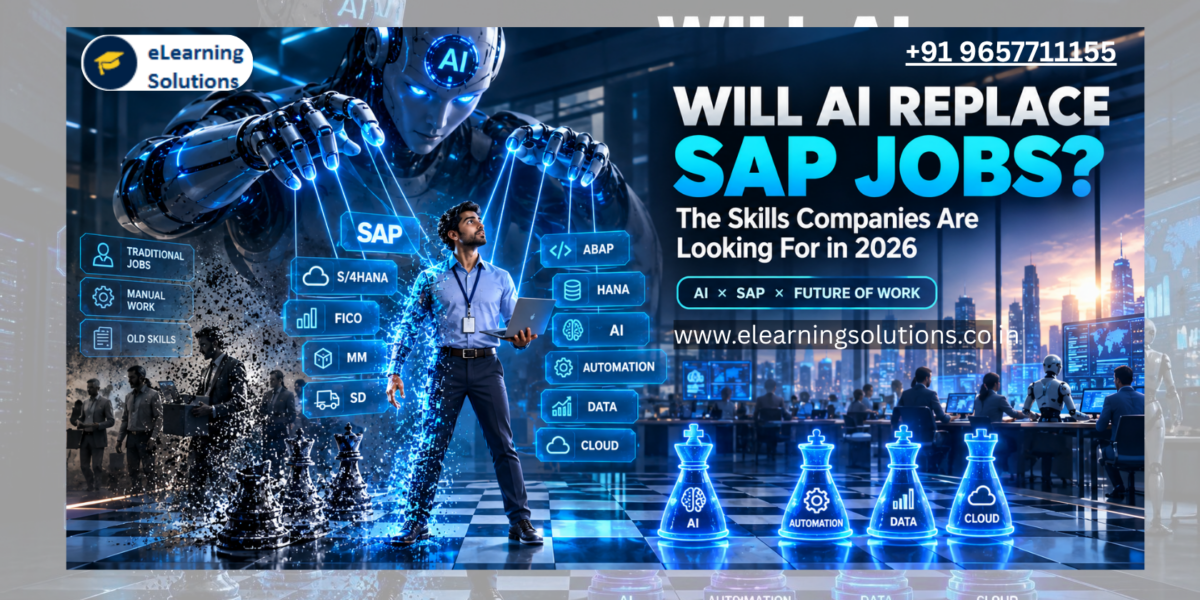
Will AI Replace SAP Jobs? The Skills Companies Are Looking For in 2026
The question of whether artificial intelligence will replace SAP jobs has moved from speculative think pieces to urgent boardroom discussions. With SAP CEO Christian Klein suggesting that AI could fundamentally alter software development roles within four years and the company reporting a 30 percent productivity gain among developers already using AI coding tools, the anxiety is understandable. Yet the reality on the ground across the SAP ecosystem tells a more nuanced and ultimately more hopeful story. The professionals who will thrive in 2026 and beyond are not those who resist this shift but those who understand exactly which parts of their work are being automated and which are becoming exponentially more valuable.
The Real Shift: Automation of Tasks, Not Elimination of Roles
The conversation often misses a critical distinction. Artificial intelligence is not walking into organizations and eliminating entire job functions wholesale. It is eating specific, repeatable tasks that have historically consumed enormous amounts of consultant time. Think about the average SAP project. A significant portion of a functional consultant’s week involves generating documentation, writing test scripts, monitoring reports for exceptions, drafting fit gap notes, and summarizing meeting outcomes. These are precisely the activities that AI tools are now handling with increasing competence.
One experienced SAP professional working in manufacturing and supply chain described how MRP exceptions that once took hours to analyze are now identified in minutes, and inventory issues are flagged before they escalate into major disruptions. This is not a threat to the consultant’s job. It is a liberation from the mundane. The same professional noted that the biggest shift is that technical expertise alone is no longer sufficient. What matters now is understanding how procurement, manufacturing, inventory, and planning all connect to serve the broader business.
This pattern repeats across the ecosystem. A developer does not need to become a data scientist, but they do need to understand where AI fits into their domain. A finance consultant does not need to become an AI engineer, but they must grasp how Joule and embedded AI capabilities can transform financial close processes. The most valuable SAP professionals of the future will combine business knowledge, SAP expertise, AI understanding, and human judgment in a way that AI alone cannot replicate.
🔥 Build these in‑demand skills with expert‑led courses at Elearning Solutions
📚 Also explore
✅ Free unlimited server access · 100% placement support · Pune’s leading training institute
What Companies Are Actually Hiring For in 2026
The hiring market for SAP talent has not contracted. It has recalibrated. With SAP ECC mainstream maintenance ending in 2027, organizations across Europe and beyond are accelerating their migration to S/4HANA, and the demand for experienced transformation talent is outpacing supply. A recruitment director in the European SAP market described the situation as a structural shift rather than a temporary spike, with S/4HANA migration programs having fixed deadlines that expose deep capability gaps.
The skills commanding premium salaries in 2026 fall into several distinct categories. S/4HANA implementation experience remains the foundational requirement. Employers are no longer interested in general SAP knowledge. They want professionals who have delivered full lifecycle migrations and understand the architectural decisions that come with moving from legacy systems to modern cloud environments.
SAP Business Technology Platform, commonly called BTP, has emerged as one of the most critical differentiators. Organizations are actively prioritizing professionals with exposure to BTP for extensions, integration, and custom development. The clean core architecture philosophy, which encourages moving custom code away from the S/4HANA core and onto BTP, has created enormous demand for professionals who understand how to design and build these extensions.
Cloud integration expertise rounds out the technical skill set. Experience with RISE with SAP, hyperscaler environments like AWS, Azure, and Google Cloud, and SAP Cloud Integration tools are no longer nice-to-haves. They are baseline expectations for senior roles.
AI Literacy as a Core Competency
One of the most significant changes in the 2026 hiring landscape is the emergence of AI literacy as a distinct and valued skill. SAP’s own survey data from Saudi Arabia found that 54 percent of organizations are upskilling or reskilling employees at scale, and 53 percent are hiring new AI-related talent. The message is clear: companies are not deploying AI in a vacuum. They are investing in people who can make AI work within their specific business context.
This means SAP professionals need to understand SAP Business AI and Joule, not as abstract concepts but as practical tools within their domain. A treasury manager who can ask Joule to prepare a CFO briefing with live data and flagged financial risks, receiving a completed presentation in minutes rather than hours, is a professional who has moved beyond traditional transaction processing into strategic value creation.
The most sought-after skill in this area is the ability to design AI use cases that solve real business problems. This requires a combination of process knowledge, technical awareness of what AI can realistically do, and the judgment to know when human oversight is essential. Organizations are looking for professionals who can identify where agentic AI should operate autonomously and where it must stop for human approval.
The Emerging Role of the AI Adoption Translator
A new category of role is crystallizing in the SAP ecosystem, one that did not exist three years ago. Companies are realizing that their AI investments are not delivering expected returns, not because the technology is inadequate but because nobody is translating SAP’s AI roadmap into a realistic, prioritized plan for their specific organization. A delivery manager writing in late 2026 described this as the biggest gap in the market: a role that sits between SAP’s capabilities and the customer’s actual business needs, answering questions like which three things Joule should do for this company, in what order, and what needs to be true first.
This role draws from every traditional SAP function. It requires functional judgment to understand what will actually work, technical understanding to know what is real versus marketing, closeness to system usage to anticipate friction points, and an obsession with measurable outcomes. Whether this becomes a formal title like AI Adoption Consultant or Innovation Lead, or remains a hat that senior professionals wear on top of their existing roles, the capability itself is in acute demand.
The trust dimension of this work cannot be overstated. Most AI value sits behind one question: will the business let an agent act? Getting a controller to trust an agent with anything that touches the ledger is a change management problem wearing an AI costume. The professionals who can navigate this successfully are rare and will become increasingly valuable.
Why Business Process Depth Matters More Than Ever
There is a counterintuitive truth emerging from the AI transformation of SAP work. As technical tasks become easier to automate, deep business process understanding becomes more valuable, not less. The consultants who struggle in the AI era are those who can configure a system but cannot explain why a particular configuration decision matters to the business. The professionals who thrive are those who understand the messy reality of how organizations actually operate.
A supply chain consultant’s observation captures this perfectly: learn the business behind the transaction, not just the transaction itself. AI can identify an MRP exception. It cannot necessarily determine whether the right response is to expedite the order, adjust the safety stock, or renegotiate the supplier terms, because that decision depends on commercial relationships, cash flow considerations, customer commitments, and strategic priorities that live outside the system.
This is why complexity protects specialist value. The more standardized an implementation, the more AI can handle the repeatable parts. But SAP environments are rarely simple. They are tangled with legacy customizations, incomplete data, integration challenges, and the accumulated compromises of years of organizational change. Navigating this complexity requires human judgment that draws on experience, intuition, and political awareness.
How SAP Itself Is Changing Its Certification Approach
SAP has made a decisive move that signals how seriously it takes the skills transition. The entire SAP certification portfolio has shifted to practical, performance based exams. Candidates now demonstrate their abilities by configuring systems, building processes, and solving real business scenarios in live SAP environments. They can even use AI tools and documentation during the exam, mirroring the working conditions they will encounter on actual projects.
More than 100,000 exams have already been taken under this new model. The certification now proves that a professional can deliver on a real SAP project rather than simply memorize theory. Role plays, situational cases, and hands-on tasks reflect the scenarios consultants face daily. This change aligns with what employers are already seeking: professionals who can hit the ground running, not professionals who can recite configuration paths from memory.
SAP has also committed to training 12 million people in AI skills by 2030, recognizing that the talent gap is one of the primary obstacles to successful AI adoption. The company’s Learning Hub has integrated AI capabilities that allow learners to interact with content in new ways, with early adopters reporting significant acceleration in onboarding and skills development.
Practical Steps for SAP Professionals in 2026
For professionals wondering how to position themselves for the next phase of the SAP ecosystem, the path forward is clearer than it might appear. The first priority is honest assessment. If a significant portion of your daily work involves producing project artifacts, documenting workshops, or repeating standard methodologies, that work is under pressure. The professionals who will remain indispensable are those who handle the messy parts: legacy complexity, data quality issues, integration challenges, business politics, and go live recovery.
The second priority is deliberate skill development in the areas companies are actively hiring for. S/4HANA transformation experience is non negotiable. BTP skills for extensions and integration are increasingly essential. Cloud integration understanding is expected at senior levels. And AI literacy, specifically the ability to identify and design AI use cases within your domain, is the emerging differentiator.
The third priority is perhaps the most important. Invest in understanding the business context of your work. The SAP systems you configure exist to serve a purpose: manufacturing products, delivering services, managing financial resources, developing people. The professionals who can connect system capabilities to business outcomes will always be in demand, regardless of what technology automates the configuration tasks.
The SAP professionals of 2030 will not compete against artificial intelligence. They will compete with professionals who know how to use AI effectively within the context of their business expertise. The question is not whether AI will replace SAP jobs. The question is which SAP professionals will adapt to a landscape where the routine parts of the work are automated and the human parts become the primary source of value.
🚀 Future‑proof your career
Join Elearning Solutions — Pune’s trusted SAP & Oracle training institute. Hands‑on labs, industry experts, and 100% placement support.
📍 Serving Pune & beyond · ⭐ 775+ registered students · 🧑🏫 50+ expert instructors




 WhatsApp us